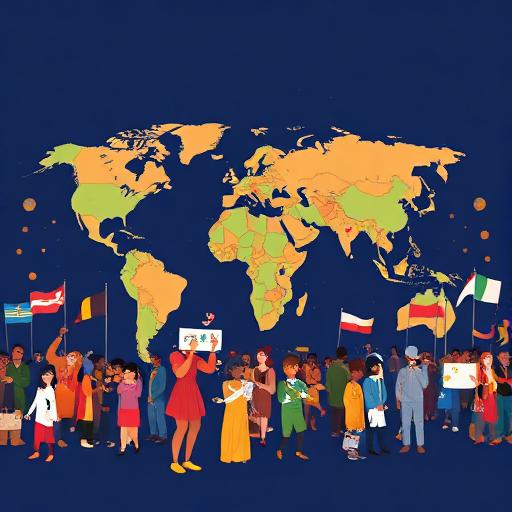
How Many Countries and People Are in the World Today?
Here's the thing about counting countries and people: it sounds like the sort of question that should have a clean, obvious answer you could look up in thirty seconds. Type it in, job done, back to your biscuit. But the honest answer is that "195 countries" is a convention, not a law of physics — and 8 billion is a moving target that shifts by the time you've finished reading this sentence. The world, it turns out, is not great at holding still.
Brandon WalkerJuly 1, 20268 min read123 views
How Many Countries Are in the World Today — and Why Everyone Argues About It
The number most people use is 195. That's the 193 United Nations member states, plus Palestine and Vatican City, which hold permanent observer status. They're not full members, but they're recognised at the table — Vatican City even has a passport, which is extraordinary given the population fits in a large car park.
If you want to be strict about it, 193 is the "official" UN figure. If you want to be practical, 195 is the number that shows up on most maps, in most geography textbooks, and in most pub quizzes.
The word "country" is doing a lot of heavy lifting here. A country needs other countries to recognise it as sovereign. That's it. There's no global tribunal handing out country certificates. Recognition is political, messy, and inconsistent — which is why this number is a convention rather than a fact carved in stone.
The answer also depends on who's asking. A diplomat says 193. A geographer might say 197. A child with a globe from 2003 says something that's no longer accurate. (Looking at you, Sudan. And South Sudan. And Kosovo.)
How Many People Are in the World Right Now
The global population hit 8 billion in November 2022. The United Nations marked the date — the "Day of Eight Billion" — on November 15th. It was less of a party and more of a statistical checkpoint, but still.
Right now, the number sits somewhere around 8.1 billion, give or take. I'd give you a more precise figure, but by the time you read this, it'll be different. The world adds roughly 140 people per minute on net — births minus deaths. That's about 200,000 people per day.
To put 8 billion in perspective: if every person on Earth stood shoulder to shoulder, they'd cover an area roughly the size of Los Angeles. The planet is not, technically, full. It just has terrible traffic management.
Getting to 8 billion took almost all of human history — and then sped up dramatically. It took 200,000 years to hit 1 billion (around 1804). Then 123 years to reach 2 billion. Then the gaps kept shrinking. We went from 7 billion to 8 billion in roughly twelve years.
Where All Those People Actually Live
They are very unevenly distributed. Two countries — India and China — account for more than a third of all humans on Earth. That's over 2.8 billion people between them.
India officially overtook China in 2023 to become the world's most populous country, a position China had held for centuries. India's population is around 1.44 billion. China's is around 1.41 billion. The gap is currently small and likely to widen as India's growth rate remains higher and China's has slowed considerably following decades of its one-child policy.
The United States is third at around 340 million. Then Indonesia, Pakistan, Brazil — all well above 200 million each.
On the other end: Vatican City has roughly 800 permanent residents. Nauru has around 10,000. These places are sovereign states with seats at diplomatic tables, populations smaller than a mid-sized English village.
Africa has 54 countries and is projected to drive most of the world's population growth this century. Europe, meanwhile, has falling birth rates across most nations. The geography of humanity is shifting — steadily and dramatically.
The Territories Nobody Agrees On
This is the edge most explainers skip past, and it's genuinely interesting.
Taiwan functions as an independent country in every practical sense — its own government, military, currency, passport, and economy. The UN does not recognise it as a member state because of the complicated relationship with China. Taiwan doesn't appear on most official country lists, but it absolutely exists and operates as a de facto sovereign state.
Kosovo declared independence from Serbia in 2008. Over 100 countries recognise it. Several major ones — Russia, China, Spain — do not. Kosovo is a UN observer but not a full member.
Western Sahara is largely controlled by Morocco but claimed by the Sahrawi Arab Democratic Republic. Palestine is an observer state at the UN but not universally recognised as a country. South Ossetia and Abkhazia declared independence from Georgia and are recognised by a handful of states, mostly Russia's allies.
None of these are academic footnotes. Real people live in these places. Their political status affects trade, travel, and international law in concrete ways. The world map is less settled than the neat coloured blocks suggest.
The Population Number Will Keep Climbing — But Not Forever
UN projections suggest the global population will peak somewhere between 10 and 11 billion, probably in the second half of this century. After that, it may gradually decline — though "gradually" in demographic terms means "over multiple generations."
The growth rate has already been slowing for decades. In 1963, the global population growth rate peaked at about 2.2% per year. It's now closer to 0.9%. The number keeps going up, but the speed at which it goes up is falling.
Fertility rates have dropped in most regions of the world. Many wealthy countries are already below the replacement rate of roughly 2.1 children per woman. Parts of East Asia — South Korea, Japan — have rates well below 1.5. Parts of sub-Saharan Africa remain above 4.
The population story isn't simply "more and more forever." It's a curve with a peak, followed by a question nobody has fully answered yet.
My Honest Take: Stop Worrying About the Exact Number
Here's my strong opinion, and I'll back it up: the obsession with pinning down an exact country count or a precise population figure is mostly a distraction from the more useful questions underneath.
The number of countries matters less than understanding which ones are contested, why they're contested, and what that tells you about how political power actually works. Knowing there are "195 countries" tells you almost nothing useful. Knowing that Taiwan is excluded from the UN despite functioning as a fully sovereign state tells you something real about geopolitics.
Similarly, "8 billion people" is a headline, not an insight. The insight is that roughly 1 billion people still lack reliable access to clean water, that population growth is concentrated in regions with the least infrastructure to absorb it, and that the demographic decline in wealthier nations creates its own set of serious pressures — pension systems, workforce shortages, healthcare costs.
I'd tell anyone not to bother memorising these numbers for their own sake. They'll be out of date within months, and they don't do any analytical work on their own. What's worth knowing is the shape of the story — where people are, where they're not, which borders are settled and which are genuinely contested, and where the growth is headed.
That's the version of this question that's actually useful at the pub. Or, for that matter, anywhere outside of a geography quiz.
The Summary
The world has 195 countries by the most practical count, 193 by the strictest UN definition, and considerably more if you include the places that count themselves but that others don't. The population is around 8.1 billion and climbing — but the rate of climb is slowing, and the peak is probably somewhere on the other side of this century. The numbers are messier than they look and more interesting than they sound. It turns out the world is quite hard to count — which, given how long it's been at this, you'd think it would've sorted out by now.
Frequently Asked Questions
It depends on who's counting. The United Nations recognises 193 member states, plus 2 observer states — Palestine and Vatican City — making 195 by most practical measures. A handful of other territories claim independence but aren't widely recognised. The short answer most people use is 195.
The global population passed 8 billion in November 2022, according to the United Nations. It's been climbing ever since. Current estimates sit somewhere around 8.1 to 8.2 billion, depending on when you're reading this. It ticks up by roughly 140 people every minute, so the number changes before you finish your tea.
India overtook China in 2023 to become the world's most populous country, with a population exceeding 1.4 billion people. China had held the top spot for decades. The United States sits in third place at around 340 million — which still sounds like a lot until you put it next to India.
Vatican City, with a population of roughly 800 people, is the least populated recognised state on the planet. For context, that's smaller than most secondary schools. Nauru and Tuvalu aren't far behind in the 'world's tiniest population' stakes, each with under 12,000 residents.
Because 'country' is a political concept, not a geographic fact. Recognition is the key — a territory needs other countries to acknowledge it as sovereign. Taiwan, Kosovo, and Western Sahara all function like countries but lack universal recognition. The UN figure of 193 members is the most commonly used baseline.
Africa has the most countries of any continent, with 54 recognised sovereign states. It's a common pub quiz stumper — most people guess Europe. Europe has around 44 to 50 depending on how you count microstates and disputed territories. Africa wins by a comfortable margin.
Global population grows by roughly 70 to 80 million people per year at present, though the growth rate is slowing. That's like adding a new Germany every twelve months. UN projections suggest the world population will peak somewhere between 10 and 11 billion before gradually levelling off later this century.
Yes — Vatican City is a fully sovereign state, the smallest in the world by both area and population. It has its own government, passports, currency, and football team (though they're not exactly giving Brazil nightmares). It's been an independent state since the Lateran Treaty of 1929.