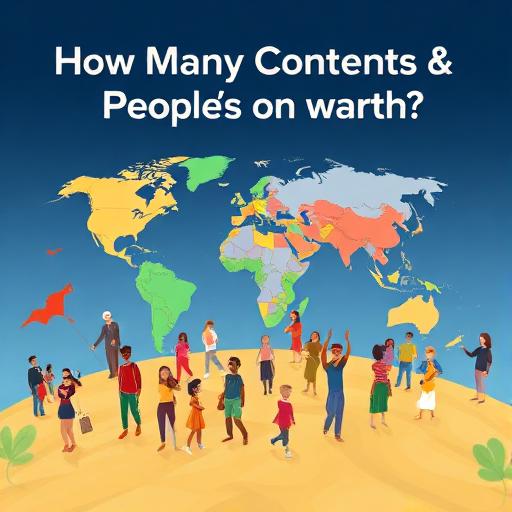
There are 7 continents, 195 countries (193 UN members plus Vatican City and Palestine), and roughly 8.1 billion people on Earth as of the mid-2020s. Those numbers sound clean and final. They're not. Continent counts vary by country, recognised nations are politically contested, and the global population changes by tens of thousands every single day.
Someone asks how many continents, countries, and people are on the world and you'd think there'd be a simple answer. You learned it in Year 4. There was a poster on the wall. It had colour-coded blobs. Done. Except geography, like a good pub argument, is never actually settled. The poster lied. The blobs are disputed. And your Year 4 teacher was working from a model that isn't universal. Let's sort this out properly — numbers, caveats, and all.
The Seven Continents — and Why Some Countries Only Teach Six
The seven-continent model is the standard in English-speaking countries, Australia, most of Europe, and China. It goes: Africa, Antarctica, Asia, Australia (sometimes called Oceania), Europe, North America, South America.
But that's not universal.
Many Latin American countries and parts of southern Europe teach a six-continent model. They merge North and South America into a single continent called "America." Some Russian and Eastern European textbooks go the other way — combining Europe and Asia into Eurasia, also landing on six.
Then there are the five-continent fans. The Olympic rings represent five inhabited continents, which is why Antarctica gets left off the flag. Sensible, arguably. Penguins don't compete. (Yet.)
The awkward truth is that the word "continent" has no scientific definition that forces a single answer. It's a cultural and educational convention. Geologically, Europe and Asia are one landmass — Eurasia. Africa and Eurasia were once connected before the Sahara and the Red Sea carved things up. The seven-continent model won out in the Anglophone world largely through educational tradition, not tectonic law.
Rule of thumb: if someone tells you the answer is "obviously" seven and there's no discussion to be had, they went to an English-speaking school and have never thought about it since. Fair enough, honestly — neither had I until someone asked.
How Many Countries There Are Depends on Who You Ask
The safest number is 195. That's 193 United Nations member states, plus Vatican City and Palestine, which hold permanent observer status. Most news organisations and textbooks use 195.
But here's where it gets genuinely messy.
Taiwan is a fully functioning democracy with its own government, military, currency, and passport. It's not a UN member because China considers it a breakaway province, and China has a veto. Kosovo declared independence in 2008. Over 100 countries recognise it. Serbia and several others don't. Western Sahara, Abkhazia, South Ossetia — the list of places that exist in political limbo is longer than you'd think.
If you count every territory that considers itself independent and has some level of international recognition, you're up around 200 to 206, depending on your thresholds. Some lists go higher.
The United States recognises 195 countries. The UK recognises 196. Different foreign policies, different diplomatic histories. No single definitive list exists that every government on Earth has signed off on.
Africa has the most countries of any continent — 54. Asia has 48. Europe sits around 44 to 47. North America has 23. South America has 12. Oceania has 14. Antarctica has zero, which makes it the world's most peaceful continent by default.
Country count is less like a maths problem and more like a group chat where everyone's still arguing about who's invited. (The United Nations is basically the world's biggest group chat, minus the memes.)
World Population: 8 Billion People and Counting Fast
In November 2022, the UN announced Earth had crossed the 8 billion mark. As of the mid-2020s, the figure sits around 8.1 billion and is rising.
That number grows by roughly 70 to 80 million people per year, net of deaths. About 140 million births happen annually. Roughly 60 million people die. The difference is why population clocks never stop ticking.
Asia holds the bulk of humanity. India overtook China in 2023 to become the world's most populous country, with over 1.4 billion people. China sits just behind. Together, those two countries account for more than a third of all humans alive.
Europe, by contrast, is shrinking in several countries. Birth rates in Italy, Germany, Japan, and South Korea have dropped well below replacement level (roughly 2.1 births per woman). The global population is still growing overall, but the growth is concentrated — primarily in sub-Saharan Africa and parts of Asia.
The UN's medium-range projection puts the global population at around 9.7 billion by 2050 and roughly 10.4 billion by 2100, before it potentially plateaus. That's not a guarantee — it's a projection based on current trends, and trends have a habit of changing when nobody's watching.
Vatican City, for what it's worth, has about 800 permanent residents. That's not a typo. It's the world's smallest country by both area and population. It has its own country code, its own post office, and its own football team. I'm not sure what their striker situation is like, but options seem limited.
The Detail Most Explainers Skip: Disputed Territories and Phantom States
Most articles give you the clean numbers and move on. Here's what they leave out.
There are entities called "states with limited recognition." These are places that function as countries — they have governments, issue passports, control territory — but aren't universally recognised internationally. Taiwan is the biggest example. Kosovo is another. Somaliland, in the Horn of Africa, has been running its own affairs since 1991 with democratic elections and a stable currency. Almost no country formally recognises it.
There are also dependent territories — places that aren't independent countries but aren't quite part of their governing nation either. Think French Polynesia, Puerto Rico, the Faroe Islands, Greenland. They have varying degrees of self-governance. They don't count as countries. But they're not exactly provinces either. They exist in a category that defies the clean continent-and-country model most of us learned.
Then there are the places that used to be countries and aren't anymore — the USSR, Yugoslavia, Czechoslovakia — and the places that might become countries in the future. Scotland, Catalonia, New Caledonia have all had independence referendums in recent memory. The map is less fixed than it looks.
Nine times out of ten, when someone quotes a firm country count, they haven't thought about Somaliland. Now you have.
The Honest Opinion: Why These Numbers Matter More Than They Seem
Here's my actual take: the vagueness around these numbers isn't a bug, it's a feature worth paying attention to.
When we treat the count of continents or countries as settled trivia, we miss the fact that borders, recognition, and geographic categories are political choices. The number of countries is partly a reflection of which governments have enough power and allies to gain international recognition. Taiwan functions as a country in every meaningful sense. It's excluded from the UN count because of geopolitical pressure from Beijing. That's not geography — that's power.
Similarly, the seven-continent model was not arrived at by scientific consensus. It's a convention that varies by educational tradition. That doesn't make it wrong, but it means treating it as an objective fact ("there are obviously seven continents") obscures how these categories were made by humans for human purposes.
As for population — 8 billion is a genuinely staggering number. For most of human history, total global population sat below 1 billion. We crossed 1 billion around 1800. We crossed 8 billion in 2022. That's 7 billion additional humans in roughly 220 years. The systems — agricultural, ecological, political — built for a much smaller population are being asked to do more than they were designed for. Understanding that the number is that big, and that it's still growing, matters for almost every major policy question of the next century.
Don't bother memorising specific country counts as if they're permanent. They change. South Sudan became a country in 2011. The USSR dissolved into 15 countries between 1990 and 1991. A list that was accurate in 1985 is wrong today. Use 195 as a working number. Know it has edges. That's a more honest relationship with the answer than pretending it's as settled as the periodic table.
The Full Count, Summed Up
Seven continents — if you went to an English-speaking school. Six, if you didn't. Five, if you're the Olympics.
195 countries — by the most widely used definition. More if you include disputed and partially recognised states. Fewer if you apply strict criteria.
Roughly 8.1 billion people, growing by about 70 to 80 million per year, with the growth concentrated in specific parts of the world and some regions actively shrinking.
These numbers are real. They're also contested, approximate, and historically contingent. The best answer is the one that knows what it's counting and why — not the one that's most confidently delivered by someone who hasn't updated their atlas since 1997.
The world, it turns out, is large, complicated, and deeply unbothered by our attempts to put clean numbers on it. Which, when you think about it, is quite on brand for something 4.5 billion years old. It was here before the borders. It'll be here after them too.