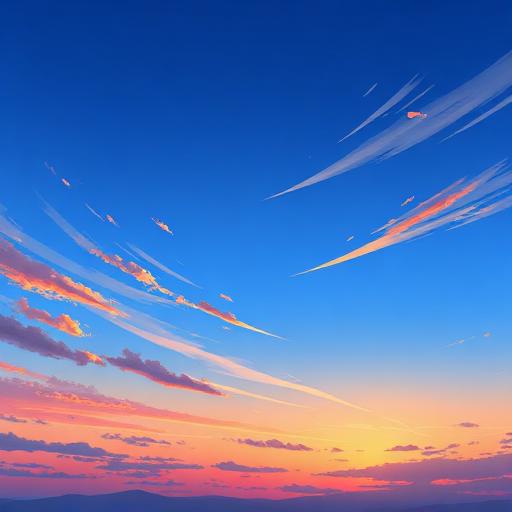
Why is the sky blue during the day and other colors at sunset? Sunlight is made of all colours. During the day, the atmosphere scatters blue light in every direction — a process called Rayleigh scattering. At sunset, sunlight travels through far more atmosphere at a low angle, blue scatters away completely, and only warm reds and oranges survive the trip to your eyes.
The sky has been pulling this colour trick for four billion years and nobody questioned it until a Victorian physicist named Lord Rayleigh finally did the maths in the 1870s. Before that, people just sort of accepted that the sky was blue the same way they accepted that soup was hot. It just was. Rayleigh ruined the mystery for everyone — in the best possible way — and now we actually know why. Buckle up, because this explanation involves wavelengths, geometry, and the atmosphere being genuinely dramatic about everything it does.
Sunlight isn't one colour — it's all of them at once
White sunlight is a mess in the best possible sense. It's a mixture of every wavelength of visible light — violet, blue, green, yellow, orange, red — all travelling together in one bundle. You can see this yourself with a prism. Newton famously did exactly that and watched white light fan out into a rainbow. He then spent the rest of his career being difficult about other things, but the prism trick still holds up.
Different wavelengths behave differently when they hit things. That's the key. Red light has a long wavelength — roughly 700 nanometres. Violet light is down around 380 nanometres. Blue sits in the middle-ish, around 450 nanometres. The difference in behaviour between these wavelengths when they hit the atmosphere is what gives us every sky colour we've ever seen.
The atmosphere itself isn't empty. It's full of nitrogen and oxygen molecules — tiny, much smaller than the wavelengths of visible light. When sunlight hits these molecules, something interesting happens. Something very blue happens, specifically.
Why is the sky blue during the day? Rayleigh scattering explained properly
Rayleigh scattering is the mechanism. Here's how it works without the full maths degree.
When sunlight strikes a gas molecule in the atmosphere, the molecule absorbs that energy momentarily and then re-radiates it. The critical thing: shorter wavelengths scatter far more intensely than longer ones. The relationship is powerful — scattering intensity is inversely proportional to the fourth power of the wavelength. That's not a typo. The fourth power.
What that means in practice: blue light, with its shorter wavelength, scatters roughly ten times more than red light across the sky. Every gas molecule in the atmosphere acts like a little blue-light sprinkler, flinging blue in every direction. Look anywhere in the sky during the day and blue light is arriving at your eyes from that direction — scattered there by a molecule somewhere up the line.
Red and orange, with their longer wavelengths, largely ignore the gas molecules and push straight through. They travel in a more direct line from the sun. Which is why, if you look directly at the midday sun (don't), it appears white-yellow rather than blue.
The sky is blue because the atmosphere is essentially a giant blue diffuser. (Any photographer reading this just nodded involuntarily.)
Why the sky turns orange and red at sunset — and why is the sky blue during the day by comparison
At midday, the sun is roughly overhead. Sunlight passes through the minimum amount of atmosphere to reach your eyes — maybe 10 to 15 kilometres of it, depending on where you are. Blue scatters all over the place, the sky looks blue, everyone's fine.
At sunset, the sun sits near the horizon. Sunlight now has to travel through a dramatically longer path of atmosphere — sometimes five to ten times more than at noon. It's the same sun. Just a terrible angle.
Here's what happens across that extended journey. Blue light gets scattered out almost immediately. Then the shorter orange wavelengths start dropping out. By the time the light reaches your eyes, the only survivors are the longest wavelengths — deep oranges and reds. They're the cockroaches of the light spectrum. Nothing kills them.
The result is those warm, saturated sunset colours. You're not seeing something added. You're seeing what's left after everything else has been scattered away. Sunsets are basically the atmosphere's way of taking everything good and sending it somewhere else. (Some of us relate to this more than we'd like.)
The detail most explainers get wrong: why not violet?
This is the edge that most "why is the sky blue" explainers quietly skip. If shorter wavelengths scatter more, and violet has a shorter wavelength than blue, then why isn't the sky violet?
Two reasons, and both matter.
First, the sun doesn't emit equal amounts of all colours. The sun's output peaks in the green-yellow range and produces relatively less violet. There's simply less violet to scatter in the first place.
Second — and this is the bigger one — human eyes are lousy at detecting violet. We have three types of colour receptors. Our blue receptors are sensitive across a range that includes blue but not much violet. Our red and green receptors contribute a little to how we see violet, but the overall sensitivity is low. Even when violet light arrives at your eye, your visual system doesn't weight it heavily.
Blue, sitting in the wavelength range our eyes handle well, wins the visibility contest. Violet does its best, scatters heroically, and gets absolutely no credit. A very relatable situation.
What makes some sunsets more dramatic than others
Clean air produces decent sunsets. Dirty air — in the atmospheric sense — produces spectacular ones. This sounds like terrible news for environmentalists and great news for photographers, and that tension is entirely real.
Extra particles in the atmosphere scatter light more. Dust from desert storms, smoke from wildfires, volcanic ash from major eruptions — all of these add scattering material at different altitudes. The result is more vivid colour spread over a wider area of sky, for longer.
The 1883 eruption of Krakatoa injected so much ash into the upper atmosphere that vivid red sunsets were reported globally for over a year afterward. Artists painted them. People panicked. Fire brigades were called out in some cities by residents who thought the horizon was burning. You have to admire an eruption that trolled an entire planet for twelve months.
Humidity affects it too. Water droplets scatter light differently from gas molecules. High humidity can soften and spread colours. Low humidity with dust gives you sharper, more saturated oranges. Rule of thumb: the more chaotic the atmosphere, the better the sunset. Which is either poetic or alarming, depending on your mood.
A strong opinion: stop explaining sunsets as "magical" — the real explanation is better
Here's my honest take. The habit of calling sunsets "magical" and leaving it there does everyone a disservice. Not because wonder is bad — wonder is great — but because the actual mechanism is more impressive than vague mysticism suggests.
Consider what's actually happening. The sun is a star 150 million kilometres away, blasting out light across all wavelengths. That light travels through space, hits a thin shell of gas around one rocky planet, and gets sorted by wavelength with such precision that the colour you see shifts predictably based on a single geometric variable — the angle of the sun. The physics is so reliable you could set your watch by it. People do, essentially. They're called sunrise and sunset.
The lazy "magical" framing also leads people to think the colours are somehow added to the sky at sunset — painted on. They're not. Sunset colours are what remains after the atmosphere removes everything else. It's subtraction, not addition. Understanding that actually makes sunsets more impressive, not less.
Where I'd tell someone not to bother: don't spend time trying to predict spectacular sunsets based on weather apps alone. The variables are too many. Dust levels, humidity, cloud type, cloud height — none of that is in a standard forecast. Your best bet is to be outside in the half hour before and after sunset consistently, and let the good ones find you. Apps and predictions will mostly disappoint. Presence is the only reliable strategy.
The physics is knowable. The specific show each evening is not. That's the actual balance between science and wonder here, and it's a better story than "magic."
Summary
The sky is blue during the day because gas molecules scatter short-wavelength blue light in every direction — Rayleigh scattering doing its thing. At sunset, sunlight travels through far more atmosphere, blue scatters out long before it reaches you, and only reds and oranges make it through. Violet scatters even more than blue but our eyes don't care. And the most dramatic sunsets happen when the atmosphere is full of extra junk. The universe runs on physics, not romance — but to be fair, it's doing a pretty convincing impression of romance every evening around 8pm. You have to give it that.