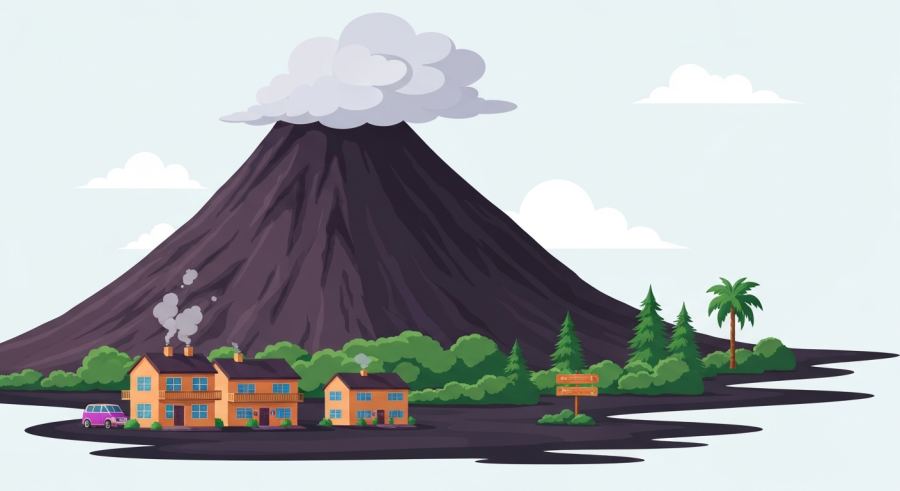
The Earth has been running its own pressure cooker for about 4.5 billion years, and it is not particularly interested in your opinion on the matter. Why do volcanoes erupt? Because the planet is hot inside, the crust is cracked, and physics is merciless. Magma finds a way. It always finds a way. Understanding the actual mechanism — not just "hot stuff goes up" — is both genuinely fascinating and, if you happen to live near one, extremely practical.
David MillerJuly 1, 20269 min read67 views
The Earth's interior is basically a pressure problem waiting to happen
Start from the inside out. Earth has a solid inner core, a liquid outer core, and a mantle — a thick layer of rock that behaves like a very slow, very hot fluid over geological timescales. The mantle sits at temperatures ranging from roughly 500°C near the crust to over 4,000°C near the core. That heat has to go somewhere.
Some mantle rock melts. When it does, it becomes magma — and magma is less dense than the solid rock surrounding it. Less dense stuff rises. Basic physics, same reason a bubble goes up in a pint glass (only slightly slower and considerably more destructive).
As magma rises through the mantle and lower crust, it collects in magma chambers — essentially underground reservoirs. These chambers grow. Pressure increases. The crust above them is not infinitely strong.
When pressure in the magma chamber exceeds the strength of the overlying rock, the magma forces its way upward through cracks and weak zones. Once it reaches the surface, we stop calling it magma and start calling it lava. Different word, same stuff. The volcano didn't create the material — it just finally let it out.
Tectonic plates are the reason why do volcanoes erupt where they do
Most volcanoes don't just appear anywhere. They cluster along specific zones, and that's not a coincidence — it's plate tectonics doing its thing.
The Earth's crust is broken into roughly 15 major tectonic plates, constantly moving at speeds of a few centimetres per year. Slow enough to ignore day-to-day. Consequential enough to build mountain ranges and rearrange continents over millions of years.
Three geological settings produce the vast majority of the world's volcanoes.
**Subduction zones.** When one oceanic plate dives beneath another plate (or beneath a continental plate), it sinks into the mantle. The descending plate carries water and minerals with it. As pressure and temperature increase, those materials are released into the mantle above. Water lowers the melting point of rock — which is one of those counterintuitive facts that sounds wrong until you look at the chemistry. The result: fresh magma. Japan, the Andes, the Cascades in the Pacific Northwest — all subduction-zone volcanoes.
**Spreading ridges.** Where plates pull apart, the mantle wells up to fill the gap. This produces quieter, more continuous eruptions. Most of these happen on the ocean floor along mid-ocean ridges. Iceland is the one place on Earth where a spreading ridge rises above sea level, which is why Iceland has so many volcanoes and so many strong opinions about geothermal energy.
**Hotspots.** More on those in a moment.
Around 75% of the world's active volcanoes sit along the Pacific Ring of Fire — a loop of subduction zones and spreading ridges circling the Pacific Ocean. It's not a ring of fire so much as a ring of unfinished geological business.
Gas is the thing that actually makes eruptions violent
Here is the part that actually explains why some eruptions are quiet and some flatten mountainsides: dissolved gas.
Magma contains dissolved gases — mostly water vapour, but also carbon dioxide, sulphur dioxide, and others. While magma is deep underground under enormous pressure, those gases stay dissolved. They're trapped. As magma rises and pressure drops, those gases start to come out of solution.
Think of opening a fizzy drink. When it's sealed, the CO2 stays dissolved under pressure. The moment you crack the cap, pressure drops and the gas comes rushing out. Now imagine the can has been shaken for a few thousand years.
If the magma is runny (low viscosity — typical of basaltic magma), gas escapes relatively easily. The eruption is gentler. You get lava flows. Tourists can get uncomfortably close and sometimes do.
If the magma is thick and sticky (high viscosity — typical of silica-rich magma like rhyolite or andesite), gas cannot escape. Pressure builds inside the magma itself. Eventually it detonates. Mount St. Helens in 1980. Pinatubo in 1991. Krakatoa in 1883. Explosive eruptions are essentially the Earth's way of saying it has been very patient and it is done being patient.
Viscosity is determined mainly by silica content and temperature. More silica, stickier magma, more violent potential. Rule of thumb: the lighter the lava colour, the more silica, the more caution warranted.
Not all volcanoes erupt the same way — and the difference matters
Volcanologists classify eruption types. The main ones worth knowing:
**Hawaiian eruptions** are the gentle, photogenic ones. Runny basaltic lava fountains and flows. Property-damaging but rarely immediately life-threatening if you don't stand in the way.
**Strombolian eruptions** involve rhythmic bursts of lava. Moderate explosivity. The Stromboli volcano in Italy has been doing this almost continuously for 2,000 years and has practically built a tourism industry around it.
**Vulcanian eruptions** are short, violent, and produce significant ash clouds and projectiles. Not the kind you set up a deckchair near.
**Plinian eruptions** are the catastrophic end of the scale. Named after Pliny the Younger, who watched Vesuvius destroy Pompeii in 79 AD and wrote the only eyewitness account to survive — which is either impressive journalism or an extremely grim coincidence, depending on your outlook. Plinian eruptions send ash and gas tens of kilometres into the stratosphere and can affect global climate.
The detail most explainers skip: hotspots
Most volcano explainers cover subduction zones and spreading ridges, then move on. They skip hotspots, which is a shame because hotspots are where it gets genuinely strange.
A hotspot is a plume of unusually hot mantle material rising from deep in the Earth — possibly from the core-mantle boundary. It punches through the crust regardless of what the tectonic plates above are doing. Hawaii sits on a hotspot in the middle of the Pacific Plate, nowhere near a plate boundary. The Pacific Plate is moving slowly northwest over the stationary hotspot, which is why the Hawaiian islands form a chain — each island is an older volcano that drifted away from the heat source, went extinct, and started eroding, while a new one forms in its place. The island of Hawaii is directly over the hotspot right now. Loihi Seamount is growing underwater to its southeast. The next island is already forming. Very slowly. Don't cancel your holiday plans.
Yellowstone is also a hotspot. The Yellowstone caldera has had three supereruptions in the last two million years. The last was roughly 640,000 years ago. Geologists monitor it carefully. The odds of an eruption happening in any given human lifetime are very low. That's the honest answer.
Here's my honest take on how worried you should actually be
Here is my one strong opinion on this topic: the media coverage of supervolcanoes like Yellowstone is wildly disproportionate to the actual near-term risk, and it gives people a distorted picture of where genuine volcanic danger actually lies.
Yellowstone captures headlines because "supervolcano" is a spectacular word and the consequences of a supereruption would genuinely be enormous. But the current monitoring shows no signs of an imminent eruption. Ground deformation, seismic patterns, and gas emissions are all within normal variation for an active geothermal system. Scientists say so, clearly and repeatedly.
Meanwhile, volcanoes that pose real, near-term risks to populated areas get far less attention. Merapi in Indonesia. Popocatépetl near Mexico City. Nyiragongo in the Democratic Republic of Congo, which sits above a city of nearly two million people and last erupted in 2021 with very little warning.
If you live near a real active volcano, the practical takeaway from understanding why volcanoes erupt is this: pay attention to the monitoring agencies. Know your evacuation routes. The science is good enough now that authorities usually have some warning before a major event. Not always — and not perfectly — but enough to act on.
If you don't live near a volcano, the takeaway is that the Earth is a remarkably dynamic, occasionally terrifying, and endlessly interesting place. The ground beneath you is not as permanent as it feels. It's just moving slowly enough that you don't notice.
Summary
Volcanoes erupt because heat builds magma, magma rises because it's buoyant, and pressure eventually wins. Tectonic plates control where most of this happens. Gas content controls how violently it goes. The science is solid, the monitoring has never been better, and the planet has been doing this for longer than anything alive has had the chance to be alarmed by it. The Earth is just venting. Honestly, after 4.5 billion years, fair enough.
Frequently Asked Questions
Volcanoes erupt because molten rock called magma builds up pressure beneath the Earth's crust. When that pressure gets too great — driven by heat from the mantle, dissolved gases, and tectonic movement — the magma forces its way through weak points in the crust and erupts at the surface as lava, ash, and gas.
Pressure builds mainly from two sources: the sheer weight of new magma being pushed up from the mantle, and dissolved gases like water vapour and carbon dioxide expanding as magma rises and external pressure drops. Think of it like shaking a fizzy drink — the gas needs somewhere to go, and eventually it goes everywhere.
Not even close. Eruptions range from slow, oozing lava flows — the kind you can outrun — to violent explosive blasts that shoot ash kilometres into the atmosphere. The difference comes down to magma composition. Thick, silica-rich magma traps gas and explodes. Thin, runny basaltic magma lets gas escape more gently, producing quieter eruptions.
Tectonic plates are massive slabs of rock that make up Earth's crust. They move constantly, very slowly. Most volcanoes form where plates collide or pull apart. At subduction zones, one plate sinks under another, melting into magma. At spreading ridges, plates pull apart and magma fills the gap. Both situations give magma a direct route to the surface.
Sometimes, but usually there are small earthquakes beforehand — they're caused by the same magma movement that precedes an eruption. Scientists actually monitor seismic activity as one of the key early warning signs. A sudden increase in small quakes under a volcano is a red flag worth taking seriously.
A supervolcano is one capable of an eruption large enough to eject more than 1,000 cubic kilometres of material. Yellowstone in the US sits on one. These eruptions are extremely rare — the last Yellowstone supereruption was roughly 640,000 years ago — but when they happen, the effects are global. Worth knowing, perhaps slightly less worth losing sleep over.
It comes down to plate tectonics. The Pacific Ring of Fire — a horseshoe-shaped zone around the Pacific Ocean — hosts around 75% of the world's active volcanoes because it's lined with subduction zones and spreading ridges. Iceland sits on a mid-ocean ridge and a hotspot, which is basically winning the geological lottery for volcanic activity.
Scientists monitor ground deformation (the ground literally swelling as magma pushes up), seismic activity, gas emissions — particularly sulphur dioxide — and changes in local gravity and temperature. No prediction is perfect, but combining these signals gives volcanologists enough lead time to warn populations. It's not an exact science, but it's far better than it was fifty years ago.