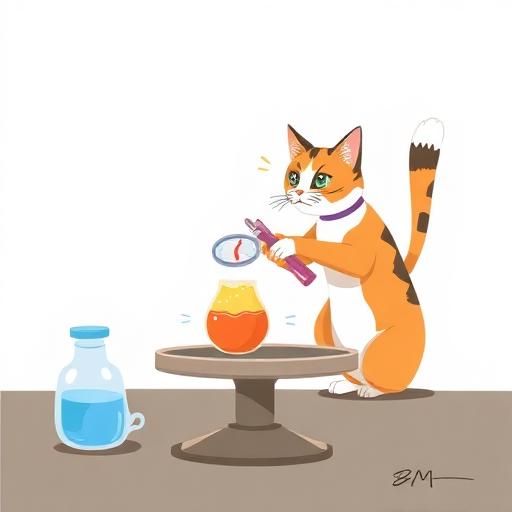
Why Do Cats Knock Things Off Tables? The Real Reason
You set your favourite mug on the counter. Your cat walks over, makes direct eye contact, and slowly —
Nicole LewisJuly 1, 20268 min read83 views
Why do cats knock things off tables comes down to three things: hunting instinct, curiosity, and attention-seeking. Cats use their paws to test objects and trigger movement — because movement means prey. If you react dramatically when something falls, you've accidentally rewarded the behaviour. It's not spite. It's a small, fluffy predator doing predator things in a house full of mugs.
deliberately — nudges it off the edge. The mug dies. The cat walks away. You stand there, defeated, wondering what you did to deserve this. The answer, as it turns out, is nothing. You did nothing. Your cat is just built this way, and understanding why is genuinely useful — both for your sanity and your crockery.
TL;DR: Cats knock things off tables because of hunting instinct, curiosity, and a calculated bid for your attention. It's not malice. It's biology with a side of manipulation.
The Hunting Brain Never Clocks Off
Cats are obligate carnivores who evolved as solitary hunters. That part of their brain — the one scanning for movement, testing objects, calculating trajectories — doesn't switch off just because they now live in a flat in Birmingham and get fed on schedule.
When a cat bats an object off a surface, the object falls. It moves. It might bounce, skitter, or roll. From a cat's perspective, that's exactly what prey does. The instinct that makes them nudge your phone off the nightstand is the same instinct that makes them crouch and stalk a leaf in the garden.
It's cause and effect, feline edition. The cat applies force, the world reacts, information is gathered. Scientists who study cat cognition reckon this is partly about testing object permanence — understanding that things exist even when they can't be seen. Cats demonstrate solid object permanence, which means they understand the mug still exists after it hits the floor. Whether they feel bad about it is a different question entirely. (They don't.)
Rule of thumb: if your cat is pawing at something repeatedly before pushing it, they're in investigation mode. If they maintain eye contact while doing it, they've moved into manipulation mode. Different problem, same broken mug.
Why Do Cats Knock Things Off Tables for Attention?
Here's where it gets personal. A lot of why cats knock things off tables is about you, specifically.
Cats are more socially aware than they get credit for. They learn what behaviours produce reactions from their humans. If you yelled, gasped, or rushed over the first three times your cat knocked something off the counter, congratulations — you've trained your cat to knock things off the counter.
They've made the connection. Shove thing off surface, human appears. It doesn't matter that the attention is negative. Cats don't particularly care about the flavour of attention, only the quantity. This is basically the feline equivalent of a toddler acting up in a supermarket. The logic is identical. The cuteness level is arguably higher.
The tell, as mentioned in the FAQs, is the eye contact. A cat staring at you while slowly pushing a pen toward the edge is not confused about what they're doing. That is a negotiation. They are telling you that the pen's fate is in your hands, and the cost of saving it is attention, food, or play. Your cat is running a hostage operation, and nine times out of ten, the hostage is a pen or a TV remote.
You could call this manipulation. I'd call it impressive. A creature with a brain the size of a walnut has figured out your behavioural patterns well enough to exploit them deliberately. Fair enough.
Boredom Is a Powerful Force of Destruction
A bored cat is a creative cat. Not in a way you'll enjoy.
Cats need between roughly 10 and 15 minutes of genuine, active play per day at minimum — and indoor cats with no access to the outdoors need more. When that need isn't met, they'll meet it themselves. Knocking things off tables, shredding furniture, zooming at 2am, and systematically destroying your pot plants are all symptoms of the same root cause: not enough stimulation.
The good news is this is fixable. Two decent play sessions a day with an actual wand toy (not just waving a piece of string half-heartedly while watching telly) makes a measurable difference to destructive behaviour. Puzzle feeders, window perches, and hiding kibble around the house are all solid options. You're essentially trying to replicate what a cat's day would look like if they had access to the outside world — lots of short bursts of activity separated by rest.
A tired cat is a well-behaved cat. That's not a metaphor. It's a management strategy. And honestly, a cat who's had a proper play session is significantly less likely to be eyeing up your 6pm glass of water with sinister intent.
The Thing Most Explainers Miss: Paws Are Sensory Organs
This is the bit that most "why do cats knock things off tables" articles gloss over, and it's actually the most interesting part.
A cat's paw pads contain a dense concentration of sensory receptors. They can detect texture, temperature, and vibration at a level that's difficult to fully appreciate from a human standpoint. Before a cat bites something, plays with it, or decides it's worth engaging with, they'll often tap it first. They're reading it.
So when your cat bats at a glass on the table, part of what they're doing is gathering information through their paws. Is this thing warm or cold? Does it move? Does it resist? What does it feel like? The fall is a byproduct of the investigation — though it's a byproduct they clearly find satisfying, which is a whole other thing.
This also explains why cats will tap your face while you're sleeping. They're not trying to wake you up. They're checking if you're alive. (And if you are alive, they'll probably knock something off the nightstand anyway, so it's a wash.)
Should You Try to Stop It? An Honest Take
Here's my actual opinion: trying to stop the behaviour entirely is wasted effort in most cases. I'd rather you focus on managing it intelligently.
Punishment doesn't work with cats. Full stop. By the time you've reacted, the cat has already moved on mentally, and they don't make the connection between the scolding and the act. All punishment does is make your cat warier of you, which helps nobody and fixes nothing. If anyone is still squirting cats with water bottles as a training method — please don't. It erodes trust without teaching anything useful.
The interventions that do work are environmental. Clear surfaces of things you actually care about. Reserve one or two "cat zones" where objects can safely be batted around without consequence. Give them more play. Get a puzzle feeder. If your cat is doing this primarily for attention, the counterintuitive move is to give them attention proactively — on your terms, before they start the performance — so they don't need to resort to hostage negotiations.
What I'd tell you not to bother with: elaborate deterrent sprays, motion-activated noise devices, or any gadget that promises to "train" your cat in three easy steps. Cats are not dogs. They don't have the same relationship with rules or consequences. You're better off arranging your environment so the temptation is removed than trying to convince a cat that the laws of cause and effect have been suspended.
Your cat will still knock one or two things over. Accept this. It's part of the deal. You knew what you were signing up for when you adopted a small apex predator and let them live in your kitchen.
Summary
Why do cats knock things off tables? Hunting instinct. Sensory curiosity. A calculated bid for your attention. Sheer, magnificent boredom. It's rarely spite, never random, and almost always solvable with more playtime and slightly better management of your own reactions. Understanding the actual reason makes it a lot easier to deal with — even if it doesn't save the mug. Your cat is a small predator who has figured out that your living room follows the rules of cause and effect, and they are running experiments. You live in their lab now. Adjust accordingly.
Frequently Asked Questions
Cats knock things off tables to test their environment, practice hunting instincts, and get your attention. It's a mix of curiosity, boredom, and the fact that a falling object behaves a lot like prey. They're not being malicious — they're just being cats, which is somehow both reassuring and infuriating.
Yes, absolutely on purpose. Cats use their paws to investigate objects before committing to them — think of it as a furry quality-control check. When something moves or falls, that's bonus information. If you react dramatically, that's even better. You've just taught them that knocking things over gets results.
Often, yes. A bored cat is a creative cat, and not in a way you'll enjoy. If your cat is regularly sending objects off shelves, they probably need more play sessions, enrichment, or stimulation. Rule of thumb: a tired cat is a well-behaved cat. Wear them out before they wear your patience out.
That's the attention-seeking version. Your cat has learned — probably from your previous dramatic reactions — that knocking things over while making eye contact produces a response. It's basically a furry hostage situation. 'Give me attention or the mug gets it.' They mean it. The mug never survives.
The act itself doesn't hurt them — cats are careful with their paws. The danger is what falls. Breakable objects, hot drinks, and heavy items can cause real harm if they shatter or land badly. Keep genuinely dangerous or valuable things out of reach. Your cat will not be grateful for this, but they will survive.
More playtime is the most effective fix, full stop. Two proper play sessions a day with a wand toy makes a noticeable difference. Beyond that, try clearing surfaces of tempting objects, using double-sided tape near vulnerable items, or providing puzzle feeders. Punishment never works — cats don't connect the scolding with the action.
Reckon it is, actually. It shows object permanence, cause-and-effect reasoning, and social manipulation — all markers of a fairly sophisticated brain. So yes, your cat is smart. Smart enough to understand that a falling glass gets your attention faster than meowing. Whether that's comforting is entirely up to you.
Pawing at objects is how cats gather information — their paw pads are packed with sensitive nerve endings. Before biting or playing with something, a cat will often tap it first to check if it moves, fights back, or tastes worth pursuing. It's the same instinct that makes them prod sleeping owners at 3am. Cheers for that.