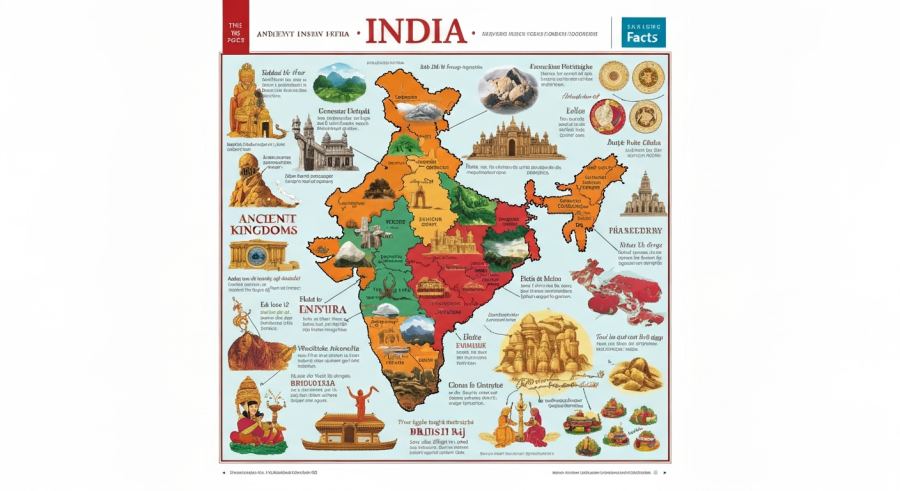
What Is India: Geography, History, and Basic Facts
India is one of those places that makes every other country feel a bit understaffed. One nation. Twenty-two official languages. Six major climate zones. Religions that shaped the entire planet. A history that makes ancient Rome look like a recent startup. Understanding what India actually is — geographically, historically, and in cold hard facts — takes more than a Wikipedia skim. So pour something cold. This is the honest version.
Megan GarciaJuly 1, 20268 min read77 views
The Geography of India: Mountains, Deserts, and Everything In Between
India is shaped like a diamond pointed south, and it means it. To the north sits the Himalayan mountain range — the tallest on Earth, still rising a few millimetres a year because the tectonic plate India rides hasn't quite finished its argument with Asia. That collision started roughly 50 million years ago. The Himalayas are the result. You could say India hit Asia and things got elevated. (I'll show myself out.)
Below the Himalayas runs the Indo-Gangetic Plain — a vast, flat, river-fed stretch of land that is among the most densely populated regions anywhere on Earth. The Ganges, Yamuna, and Brahmaputra rivers cut through here. This is where the majority of India's population lives and most of its food is grown.
To the northwest is the Thar Desert, shared with Pakistan, where temperatures swing from brutal heat to genuine cold depending on the season. To the south, the land narrows into a peninsula surrounded by three bodies of water: the Arabian Sea to the west, the Bay of Bengal to the east, and the Indian Ocean below. The southwestern coast — Kerala and Goa — is lush and tropical. The Deccan Plateau sits in the centre-south, an ancient, elevated slab of land that drains into coastal rivers.
India shares borders with Pakistan, China, Nepal, Bhutan, Bangladesh, and Myanmar. Sri Lanka sits just 31 kilometres off its southern tip. The Andaman and Nicobar Islands, technically Indian territory, are closer to Thailand than to Chennai.
Rule of thumb: if you're trying to picture the geography, think of it as three broad bands — Himalayan north, flat central plains, peninsular south — each with its own climate, culture, and character.
India's History: From the Indus Valley to Independence
India's recorded history starts around 3300 BCE with the Indus Valley Civilisation, one of the world's earliest urban societies. Cities like Mohenjo-daro and Harappa had grid-planned streets, drainage systems, and standardised weights — while most of Europe was still working out agriculture. These people were, by any measure, ahead of schedule.
The Vedic period followed, roughly 1500–500 BCE, during which the foundational texts of Hinduism were composed. Buddhism and Jainism both emerged in the 6th century BCE, within the same general region and, remarkably, within decades of each other. India was having a philosophical moment.
The Maurya Empire, peaking under Ashoka in the 3rd century BCE, unified most of the subcontinent for the first time. Ashoka converted to Buddhism after a particularly brutal military campaign and spent the rest of his reign promoting non-violence — a genuinely unusual arc for an ancient emperor.
The Gupta period (roughly 4th–6th century CE) is often called India's Golden Age. Mathematics, astronomy, literature, and medicine all advanced significantly. This is where the concept of zero was formalised, which means India gave the world the ability to represent nothing — and somehow we still can't stop filling the void.
The Mughal Empire arrived in the 16th century and dominated the subcontinent for roughly 200 years. The Taj Mahal, completed in 1653, is its most visible legacy. British influence crept in through the East India Company from the 1600s and hardened into formal colonial rule after 1857. India gained independence on 15 August 1947 — simultaneously with the creation of Pakistan through Partition, one of the most violent and traumatic border-drawings in modern history.
Basic Facts About India Worth Actually Knowing
Let's get concrete. Here are the numbers and facts that actually matter.
India covers 3.29 million square kilometres, making it the seventh-largest country by land area. Population sits at roughly 1.4 billion — surpassing China as the world's most populous country around 2023.
The official name is the Republic of India. The capital is New Delhi. The currency is the Indian Rupee (INR). The national language situation is complicated: Hindi is most widely spoken, English is co-official at the national level, and 22 languages total hold official status. There are hundreds more spoken across the country.
India has 28 states and 8 union territories. The largest state by area is Rajasthan. The most populous is Uttar Pradesh, home to over 200 million people — more than most countries.
The country produces more films per year than any other nation. Cricket is the dominant sport. The national animal is the Bengal tiger. The national bird is the Indian peacock. The national fruit is the mango, which frankly feels like a decision made by someone in a very good mood.
India is the world's largest democracy by voter count. General elections involve over 900 million eligible voters and take weeks to complete across the country.
The Political Structure: How India Actually Runs
India is a federal parliamentary republic. There's a President as head of state, but the real executive power sits with the Prime Minister and the Council of Ministers. Parliament has two houses: the Lok Sabha (lower house, directly elected) and the Rajya Sabha (upper house, indirectly elected by state legislatures).
Each state has its own government, legislature, and significant autonomy over local matters. The Supreme Court sits at the top of the judicial system and has broad powers — including the ability to strike down legislation that conflicts with the Constitution.
The Constitution of India, adopted in 1950, is one of the longest written constitutions in the world. It runs to roughly 145,000 words in its English version. (The US Constitution is about 7,500. Different approach.)
The Angle Most Explainers Skip: India's Internal Diversity Is Country-Scale
Most summaries treat India as a single unified culture. That's a bit like describing Europe as "the place with pasta and rain."
The difference between Tamil Nadu in the south and Punjab in the north is not merely regional flavour. It's language, script, food, music, religious practice, skin tone, architecture, and centuries of distinct history. A Tamil speaker and a Punjabi speaker cannot communicate without a third language — usually English or Hindi, depending on who you ask and how the conversation is going.
Nine times out of ten, when someone generalises about "Indian culture," they're describing one region, one caste context, one era. The reality is that India contains within itself what would — in Europe — constitute a dozen separate nations, each with its own literature and festivals and ancient grudges.
This is not a criticism. It's the point. India's experiment in holding that much diversity inside a single democratic framework is, depending on your view, either a remarkable achievement or a permanent work in progress. Probably both.
An Honest Opinion: What "Knowing India" Actually Requires
Here's my strong take: most Western summaries of India — including, honestly, many that appear in respectable publications — underestimate how much the subcontinent's diversity complicates every single generalisation.
Textbooks and travel guides tend to lean on a handful of images: the Taj Mahal, Bollywood, spicy food, spirituality, poverty. These aren't wrong, exactly. But they're like describing the United States as skyscrapers, hamburgers, Hollywood, and gun violence. Technically present. Wildly incomplete.
The honest version of "what is India" is that it's a political and constitutional project as much as it is a cultural one. The idea that 1.4 billion people with distinct languages, religions, and regional identities can operate as a single democratic state is not something anyone should take for granted. It's a live experiment, and it's been running since 1950.
Where I'd push back on the standard explainer: don't bother treating India as a monolith when you're trying to understand it. It wastes your time. Pick a region, a period, a specific cultural or political thread, and follow that. You'll learn more from three weeks on the history of South Indian temple architecture than from six general-purpose "India explainers." The subcontinent rewards specificity.
That said — if what you need is a working overview, you now have one. The geography stacks from Himalayan north to peninsular south. The history runs 5,000 years without a clean break. The democracy is the biggest in the world by voter count. And the mango, officially, is the national fruit. Some facts just deserve repeating.
Summary
India is the world's most populous country, its largest democracy, and one of its oldest continuous civilisations. It spans a subcontinent of deserts, plains, and mountains. Its history runs from the Indus Valley through the Mughals and the British to a republic born in 1947. Its diversity is the kind that resists summary — which is, of course, exactly why people keep trying to write one. Including, it turns out, this bloke right here.
Frequently Asked Questions
India is a country in South Asia, bordered by Pakistan to the northwest, China and Nepal to the north, Bangladesh and Myanmar to the east, and the Indian Ocean to the south. It's the seventh-largest country by area and the most populous on Earth, home to roughly 1.4 billion people.
New Delhi is the capital of India. It sits in the northern part of the country and serves as the seat of the Indian government. It's distinct from Delhi, the larger urban territory that surrounds it — though locals will tell you the difference mainly matters to bureaucrats.
India has 22 officially recognised languages, with Hindi and English being the two used at the national government level. Hindi is the most widely spoken, but states like Tamil Nadu, West Bengal, and Maharashtra have their own dominant languages. Assuming everyone speaks Hindi will get you a polite but firm correction.
India has one of the world's oldest continuous civilisations, starting with the Indus Valley Civilisation around 3300 BCE. It saw the rise of major empires including the Maurya and Mughal, then British colonial rule from the 1700s until independence in 1947. Partition created Pakistan simultaneously, one of history's most painful borders.
Hinduism is the majority religion, practised by roughly 80% of the population. India is also home to significant Muslim, Christian, Sikh, Buddhist, and Jain communities. It's the birthplace of Hinduism, Buddhism, Jainism, and Sikhism — which makes it arguably the most religiously productive piece of real estate in human history.
India is currently the fifth-largest economy in the world by nominal GDP and the third-largest by purchasing power parity. It's a mixed economy with major sectors in IT services, agriculture, manufacturing, and pharmaceuticals. Growth has been strong in recent decades, though inequality and rural poverty remain genuine, stubborn challenges.
India sits on a tectonic plate that literally crashed into Asia millions of years ago, forming the Himalayas in the process. The resulting landmass is so geographically distinct — bounded by mountains and ocean — that geographers call it a subcontinent. It's essentially a continent that didn't quite make the cut. No hard feelings.
India covers about 3.29 million square kilometres. It has 28 states and 8 union territories. The Ganges is its most sacred river. Cricket is basically a religion. It produces more films annually than any other country. And it invented zero — which, without it, the rest of maths would be going absolutely nowhere.