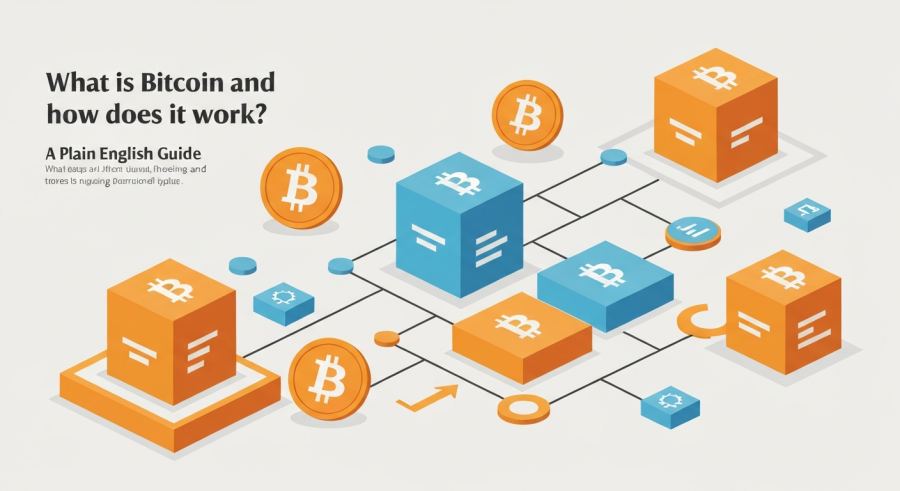
Bitcoin is a decentralised digital currency — meaning no bank, no government, no middleman. It runs on a technology called the blockchain, a public ledger where every transaction is recorded and verified by a global network of computers. You can send it to anyone, anywhere, without asking permission. There are only ever 21 million Bitcoin. That's the whole deal.
Most people have heard of Bitcoin. Far fewer can actually explain what is Bitcoin and how does it work without either glazing over or descending into breathless hype about "the future of finance." The honest truth is it's genuinely clever, genuinely weird, and doesn't require a computer science degree to understand. It does require about ten minutes and a willingness to question why we trust banks in the first place. Grab a drink. This won't hurt.
Bitcoin is money, but weirder — and that's the point
Regular money — the pounds, dollars, or euros in your account — exists because a government says it does. A central bank controls how much of it exists. Commercial banks sit in the middle of every transaction you make. You trust the system because it mostly works and because you haven't got a better option.
Bitcoin was designed to remove all of that. Created in 2008 by someone (or someones) using the pseudonym Satoshi Nakamoto, it launched in 2009 as a direct response to the financial crisis. The idea was simple and radical: what if money worked peer-to-peer, like email, with no institution in the middle?
When you send Bitcoin to someone, it goes directly to them. No bank approves it. No payment processor takes a cut. No business hours. No "please allow three to five working days." It's the financial equivalent of handing someone cash — except it works internationally and at any hour. You could say Bitcoin is always working the night shift. (Unlike your bank's customer service line.)
The catch, and it's a real one, is that there's no central authority to call if something goes wrong. No fraud department. No chargeback. Responsibility sits squarely with the user. That's either liberating or terrifying depending on how you feel about personal accountability.
The blockchain is just a very stubborn spreadsheet
This is where what is Bitcoin and how does it work gets slightly technical — but bear with me, because it's actually elegant.
Every Bitcoin transaction ever made is recorded on a public ledger called the blockchain. Picture a spreadsheet that lists every transfer: who sent what, to whom, and when. That spreadsheet doesn't live on one server. It lives on thousands of computers simultaneously, all over the world. Every copy is identical.
Transactions are bundled together into "blocks." Each block is cryptographically linked to the one before it, forming a chain. To alter any transaction, you'd need to rewrite that block and every block after it — simultaneously on the majority of those thousands of computers. The maths makes that effectively impossible. That's why "immutable" gets thrown around so much. It's accurate, if a bit dramatic.
The blockchain doesn't care who you are. It only cares about cryptographic proof that you have the right to spend the coins you're claiming to spend. No ID. No credit score. No "we've noticed unusual activity on your account." Just maths.
Nine times out of ten, when someone says blockchain is going to revolutionise something, they're overselling it. But for Bitcoin specifically, it's the actual mechanism that makes the whole thing work. It's the pub quiz answer that's actually correct.
Mining: how new Bitcoin gets made (and why it costs a fortune)
Bitcoin doesn't get printed. It gets mined — computationally, not with a pickaxe. (Though given the energy bills involved, a pickaxe might be cheaper.)
Miners are computers — massive banks of specialised hardware — that compete to solve a complex mathematical puzzle. The winner gets to add the next block of transactions to the blockchain. As a reward, they receive newly created Bitcoin. This is called the block reward.
The puzzle is deliberately hard. It has to be. The difficulty adjusts roughly every two weeks so that a new block is found about every 10 minutes, regardless of how much computing power is on the network. More miners join, puzzle gets harder. Some leave, puzzle gets easier. It's self-regulating, which is genuinely impressive for something with no management team.
Here's the key part: the total supply of Bitcoin is capped at 21 million. Roughly 19.5 million have already been mined. The block reward halves approximately every four years — an event called the "halving." Eventually, the reward reaches zero and no new Bitcoin will ever be created. Scarcity is baked in at the protocol level. No committee vote required.
Wallets, keys, and why losing a piece of paper ruins your day
Bitcoin doesn't sit in an account the way money sits in a bank. What you actually own is a private key — a long string of characters that proves you control a specific amount of Bitcoin on the blockchain.
A Bitcoin wallet is the software or hardware that manages these keys. It's less like a wallet and more like a keychain. Lose the keys, lose access. Forever. There's no "forgot my password" button. No customer support ticket. Estimates suggest millions of Bitcoin are permanently inaccessible because people lost or discarded their keys in the early days. One man famously threw away a hard drive containing thousands of Bitcoin and has been unsuccessfully trying to search a landfill for it ever since.
Rule of thumb: if you hold more Bitcoin than you're comfortable losing entirely, get a hardware wallet. These are physical devices that store your private keys offline, away from hackers. Not glamorous. Not exciting. Absolutely worth it.
The thing most explainers skip: what happens when all 21 million are mined
This one gets ignored surprisingly often, and it's actually a fascinating unsolved question about Bitcoin's long-term design.
Right now, miners are incentivised to secure the network through block rewards. But as halving events continue and the reward shrinks toward zero, transaction fees become the only compensation. The question nobody has a definitive answer to is whether transaction fees alone will be enough to keep miners securing the network at scale.
If mining becomes unprofitable and miners leave, the network becomes easier to attack. Bitcoin's designers clearly thought about this — the fee market exists for a reason — but whether it works at the scale required remains genuinely open. It won't be an issue for decades. But it's the kind of structural question that separates serious analysis from price-prediction hype.
Most Bitcoin articles never mention this. That's not because it's a fatal flaw. It's because it requires holding two thoughts at once: Bitcoin is impressive and it has unresolved questions. Both things are true.
My honest take: Bitcoin is real, the hype is not
Here's the opinion you probably didn't ask for but are getting anyway.
Bitcoin is a genuine technological achievement. The blockchain as a solution to the double-spend problem — how do you stop someone spending the same digital coin twice? — is clever. The 21 million cap is a genuine innovation in monetary policy. The network's uptime over fifteen-plus years is remarkable for something with no central operations team.
What it is not is a guaranteed investment. Bitcoin has lost more than 80% of its value on multiple occasions. It recovered each time — so far. But "so far" is doing a lot of work in that sentence. Anyone telling you Bitcoin only goes up has either a very short memory or something to sell you.
It is also not the right tool for everyday small purchases right now. Transaction fees and confirmation times make it poorly suited for buying a coffee. The Lightning Network — a layer built on top of Bitcoin — attempts to solve this, but adoption is still limited.
Don't bother with Bitcoin if you need guaranteed returns, can't stomach serious volatility, or are hoping to get rich in six months. It has historically rewarded people who understood what they owned, bought it with money they could afford to lose, and then mostly left it alone. That's not a hot take. That's just what the data shows.
So where does that leave you?
Bitcoin is a decentralised digital currency running on a public blockchain, secured by cryptographic proof and competitive mining, with a fixed maximum supply of 21 million coins. It's not magic. It's not a scam. It's not guaranteed to make you rich. It is one of the more interesting experiments in monetary history — and unlike most experiments, this one has a live price ticker you can watch every five minutes if you want to absolutely ruin your evening.
Now you know what it is. What you do with that information is, fittingly, entirely up to you — no middleman required.