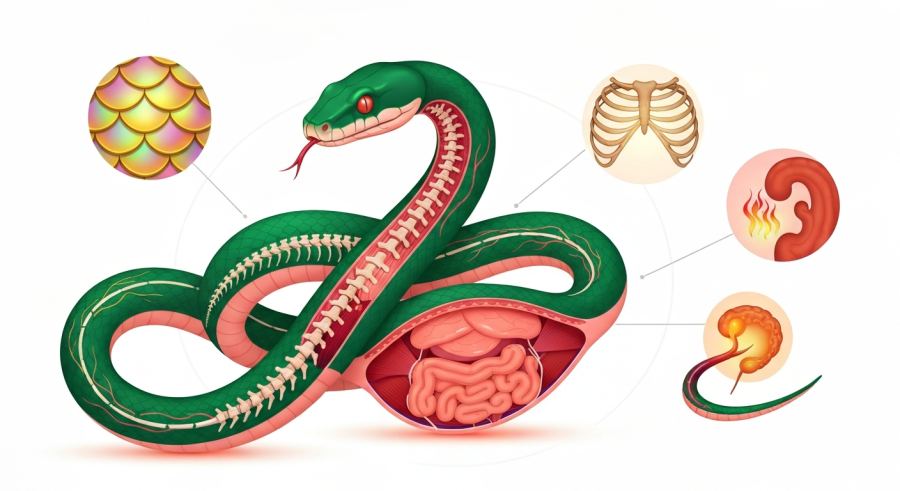
A snake is a limbless reptile in the suborder Serpentes, with roughly 3,900 known species. Biologically, they work through a combination of a highly flexible skeleton (up to 400 vertebrae), specialised jaw mechanics, chemical-sensing tongues, and a slow metabolism that makes them extraordinarily efficient predators without burning much energy to do it.
Snakes are either terrifying or fascinating, depending on your personality type — and sometimes both at once. There is no animal on Earth quite like them. No legs. No eyelids. No external ears. Just scales, muscle, and an absolutely unnerving ability to swallow something three times the size of their head. If you've ever wondered exactly what a snake is and how the biology actually works underneath all those scales, you're in the right place. This is the full picture, minus the dramatics and the dodgy YouTube thumbnails.
What a snake actually is (and what it isn't)
Snakes are reptiles — specifically, they belong to the suborder Serpentes within the order Squamata, which they share with lizards. They're not a type of worm. They're not amphibians. They are cold-blooded vertebrates covered in overlapping scales made of keratin (same stuff as your fingernails, since you asked).
There are roughly 3,900 known species. They live on every continent except Antarctica and in most marine environments too. The smallest, the Barbados threadsnake, is about 10 centimetres long. The largest, the reticulated python, regularly exceeds 5 metres and occasionally exceeds 7.
Snakes evolved from lizard ancestors roughly 100 million years ago. The leading theory is they developed their limbless form either as burrowing specialists or as aquatic hunters — the fossil record still argues about it. What's not disputed: they lost their legs gradually, kept the vertebrae, and ran with it. Literally. Well, slithered.
They are not slimy. This is the most common misconception. Snake scales are dry and smooth. The slimy reputation is borrowed from worms and amphibians, and snakes have been wrongly paying for it ever since.
The skeleton: how 400 vertebrae make a working animal
A human has 33 vertebrae. A snake can have anywhere from 200 to 400, depending on species. Each one articulates with the next through multiple interlocking joints, giving the whole body extraordinary flexibility in the horizontal plane.
Every vertebra (except those in the tail) has a pair of ribs attached to it. Those ribs don't connect to a sternum like ours do — they float freely and attach instead to muscles and skin. This is crucial for movement and for swallowing. The skull is where things get really interesting.
Snake skulls are made of loosely connected bones held together by elastic ligaments. The left and right sides of the lower jaw operate independently. The quadrate bones act as flexible hinges. There's no chin connecting the two sides. What this means in practice: a snake can open its mouth to roughly 150 degrees and manipulate prey into its throat using alternating left-right movements of the jaw — a process called "pterygoid walking." It's equal parts brilliant and unsettling to watch.
They don't "unhinge" their jaws — that phrase is technically wrong and makes it sound more dramatic than it needs to be. The mechanics are impressive enough without the exaggeration.
How snakes move without a single leg to stand on
Four main movement modes. Pick the right one for the terrain.
Lateral undulation is what you picture when you picture a snake moving. The body forms S-shaped curves and pushes backward and outward against surface irregularities — rocks, grass, bark. Each contact point generates thrust. Fast, efficient, scales brilliantly with body length.
Rectilinear movement is slow straight-line crawling. Large boas and pythons use this. Belly scales grip, muscles lift and extend sections of the body forward in waves. It looks like the snake is barely moving. It also looks extremely calm, which is frankly intimidating.
Sidewinding is used on loose, slippery sand by desert species like the sidewinder rattlesnake. Only two contact points touch the ground at once, reducing slipping on unstable surfaces. It looks bizarre. It is actually extremely efficient.
Concertina movement is for tight tunnels and tree branches. The snake anchors the rear, extends the front, grips, then pulls the rear up. Like an accordion. Hence the name. Slower than lateral undulation but effective where wiggling sideways isn't possible.
All four methods are powered by hundreds of interlocking muscles running between vertebrae, ribs, and skin. A snake's musculature is extraordinary — one of the most complex muscle arrangements in any vertebrate.
Senses: tongues, pits, and vibrations through bone
Snakes have no external ears. They do not hear airborne sound the way we do. Instead, they detect ground vibrations through their lower jaw bones, which are in direct contact with the substrate. Those vibrations travel to a structure called the columella and then to the inner ear. Not useless — just very different.
Their eyes are covered by a transparent scale called the brille (or spectacle) instead of a moveable eyelid. This is why snakes appear to stare. They're not intensely focused on you. They literally cannot blink. The brille is shed along with the rest of the skin during moult — which means snakes go temporarily blind just before they shed, hence why they get more defensive around shedding time.
The forked tongue is a delivery mechanism. It picks up airborne scent particles and delivers them to two openings in the roof of the mouth, where the Jacobson's organ (vomeronasal organ) processes the chemical information. The fork matters — each tine collects slightly different concentrations, giving directional information about where a scent is coming from.
Pit vipers, pythons, and boas have a bonus sense: infrared-detecting pit organs. In pit vipers these sit between the eye and nostril. In pythons and boas they're labial pits along the lip. These detect temperature differences as small as 0.003°C, effectively giving the snake a thermal image of its environment. Useful if you hunt warm-blooded prey in the dark. Also the inspiration for every sci-fi thermal imaging scene ever filmed.
Digestion, metabolism, and the art of the long lunch
Snakes are ectotherms — they rely on external heat sources to regulate body temperature. This is why they bask in the sun. The sun is their thermostat. A warmer body runs faster enzymatic reactions, which matters enormously during digestion.
Snakes have a slow metabolic rate compared to mammals of similar size. This is not a flaw — it's the whole game plan. They can go weeks or months between meals because they're not burning energy to stay warm. A large python can survive over a year without eating, though that's an extreme case, not standard operating procedure.
When they do eat, digestion is an industrial process. Stomach acid strong enough to dissolve bone. Organs that were dormant between meals ramp up rapidly after a meal — the intestines increase in mass, the pancreas and liver kick into high gear. The heart actually grows measurably after a large meal to handle the increased circulatory demand. A snake's body essentially powers down between meals and reboots for digestion. It is, genuinely, remarkable.
Venom, where present, is a modified salivary secretion. It's delivered through grooved or hollow fangs, depending on the species. Venom is expensive to produce biologically, which is why snakes use it as a last resort for defence — most would rather flee. "Defensive bite" is the rule of thumb. Offensive, predatory bites on prey are a different context entirely.
The bit most explainers skip: how snakes breathe while eating
Here's the detail nine out of ten snake articles leave out, and it's genuinely clever biology.
When a snake swallows large prey, its throat can be completely blocked for an extended period. Mammals would suffocate. Snakes don't, because they have a structure called the glottis — the opening to the trachea — at the very front of the mouth, near the tip of the lower jaw. During swallowing, the snake extends the glottis outward past the obstructing prey so it protrudes and can still take in air.
The trachea itself is reinforced with cartilage rings that prevent it from being compressed under the pressure of swallowing. Some snake species also have a tracheal lung — an extension of lung tissue into the upper trachea — which provides additional respiratory surface when the main lung is compressed by a large meal.
This is the kind of engineering that makes evolutionary biologists genuinely excited. Every meal is also a potential suffocation event, and the snake's anatomy has solved this problem with an elegance that most engineering textbooks would envy. Most snakes also have a reduced or absent left lung — the right lung handles most of the work, shaped to fit the long narrow body cavity without getting in the way of all those other organs.
The honest opinion: why snakes are misunderstood in exactly the wrong direction
Here's my take: the public conversation about snakes gets the danger question exactly backwards.
Most people overestimate the threat from common snake species and massively underestimate the biological sophistication of the animal in front of them. When someone encounters a garden snake and treats it like a sea serpent from mythology, they're not just being irrational — they're also missing something genuinely extraordinary.
The real story of snakes is this: they are among the most specialised vertebrates on the planet. Their entire body plan is a single, highly optimised solution to the problem of hunting without limbs. The flexible skeleton, the chemical senses, the heat pits, the digestive ramp-up, the glottis trick — none of this is simple. It took tens of millions of years of evolution to produce.
If you encounter snake content that spends more time on "are they dangerous" than on how they actually function, you're reading the wrong content. The danger question, statistically, matters far less than most people think. Of the roughly 3,900 species, fewer than 200 pose a meaningful risk to humans. Globally, snakebite mortality is a real public health issue concentrated in specific regions — largely South and Southeast Asia and sub-Saharan Africa — and is almost entirely linked to lack of access to antivenin, not to some inherent aggression in snakes themselves.
Most snakes, given the option, flee. A bite is the expensive backup plan. They'd rather just leave.
The recommendation: don't bother treating snakes as threats to categorise and avoid. Treat them as what they are — one of evolution's more impressive experiments. Even the dangerous ones are doing something fascinating at the biological level. You can respect the risk and still appreciate the animal. These are not mutually exclusive.
Summary
Snakes are legless reptiles with up to 400 vertebrae, independently moving jaw bones, chemical-sensing tongues, a slow metabolism built for efficiency, and in many species, the ability to detect infrared heat. They move through four distinct methods, breathe through an extendable glottis during meals, and have been misunderstood by humans for most of recorded history. They're not slimy. They're not aggressive by default. They are, however, genuinely extraordinary — which is more than you can say for most things that make people stand on a chair and scream. Now you know what a snake is and how they work biologically, the next time one crosses your path, you'll at least appreciate the engineering, even if you'd still rather it crossed somewhere else.