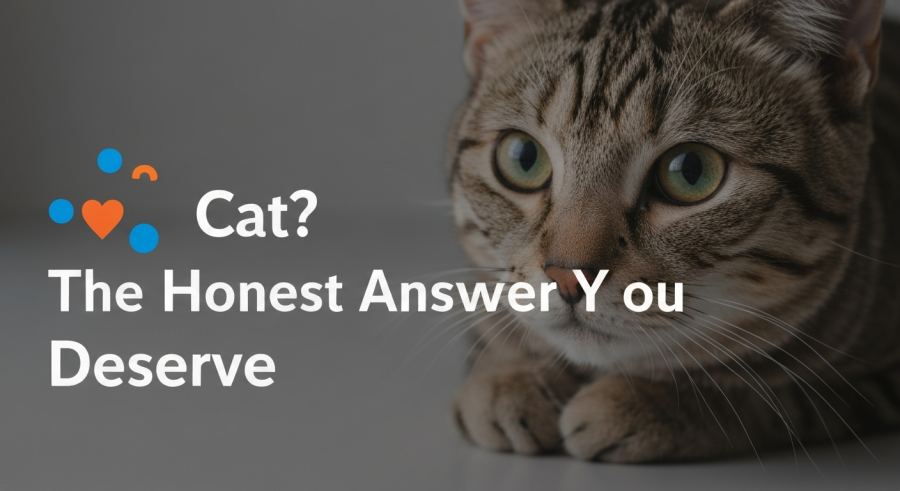
What is a cat? A cat is Felis catus — a small, domesticated, obligate carnivore in the family Felidae. Domesticated roughly 10,000 years ago in the Near East, cats are apex predators scaled down to sofa-size, with retractable claws, binocular vision, and a social life they'll share with you only on their own terms.
You've probably shared a bed with one. Maybe argued with one over a chair. Possibly lost. And yet — if someone asked you to actually explain what a cat is, you'd likely wave your hand and say "you know, a cat." This article is for every person who deserves a better answer than that. What is a cat, really? Biologically, historically, behaviourally? Turns out the answer involves Near Eastern wildcats, bone-healing sound frequencies, and a level of evolutionary self-confidence that most of us can only dream about.
What Is a Cat, Biologically? (More Tiger Than You'd Think)
Felis catus. That's the Latin. You can drop that at your next dinner party and watch people slowly edge away.
Cats belong to the family Felidae — the same family as lions, tigers, cheetahs, and leopards. They share roughly 95% of their genome with tigers. Pause on that. The creature sleeping on your radiator is, at a genetic level, almost a tiger. A very small, very lazy tiger who refuses to hunt anything unless it moves across a screen.
Cats are obligate carnivores. This is non-negotiable biology. Unlike dogs — or humans — cats cannot synthesise certain amino acids, like taurine, on their own. They must get them from animal tissue. A cat fed a vegetarian diet will go blind and die. No judgement on lifestyle choices, but that's just the deal.
Key biological specs, since we're being thorough:
- Average lifespan: 12-18 years domestically, roughly half that in the wild
- Heart rate: 140-220 beats per minute (yours is probably 60-100, so they're running hot)
- Field of vision: around 200 degrees, versus the human 180
- Hearing range: up to roughly 64,000 Hz — they hear sounds you'll never hear, which explains a lot of the staring-at-nothing behaviour
A cat's skeleton has more bones than a human's — around 230, versus our 206. Most of that is spine. That extraordinary spinal flexibility is why they move the way they do and why they can fit into a box that, by rights, should not contain them. (Physics, apparently, is more of a suggestion to a cat.)
How Cats Became Domestic — Sort Of
Here's the thing about cat domestication: cats did it themselves.
Around 10,000 years ago, humans in the Near East started farming. Grain stores attracted rodents. Rodents attracted wildcats — specifically Felis silvestris lybica, the African wildcat. The cats that were bold enough to hang around humans got easy meals. Humans got free pest control. A deal was struck, without anyone signing anything.
This is fundamentally different from how dogs were domesticated. Dogs were actively bred by humans over thousands of years for specific tasks. Cats wandered in, assessed the situation, decided the mice-to-effort ratio was acceptable, and stayed. The cat equivalent of "yeah, this job'll do."
Genetic evidence suggests this happened at least twice — once in the Near East and once, independently, in Egypt. The Egyptians in particular took cats seriously. Killing one, even accidentally, was punishable by death. Cats were associated with the goddess Bastet. Entire cemeteries full of mummified cats have been found. That is a level of societal commitment to cats that modern Instagram hasn't quite matched, but give it time.
Here's the kicker: domestic cats are barely genetically different from their wild ancestors. The domestication changes are largely behavioural — they tolerate humans, they vocalise more (adult wildcats are mostly silent), and they're comfortable in closer social proximity. Structurally? Still a predator. Still absolutely capable of surviving without you. They're just choosing not to.
What Cats Actually Do and Why
Cats sleep between 12 and 16 hours a day. Sometimes more. This is not laziness. It's caloric strategy. A predatory sprint costs enormous energy. Conserving energy between hunts is the whole game. Your cat isn't idle — it's tactically resting. (I reckon my cat is tactically resting right now and has been since 2019.)
When cats are awake, they spend a significant chunk of time grooming. Roughly 30-50% of waking hours. This serves multiple purposes: parasite removal, temperature regulation, scent management so prey can't smell them coming, and social bonding when done between cats. It's not vanity. It's maintenance.
The kneading behaviour — that slow, alternating push of the paws you get when a cat settles on you — comes from kittenhood. Kittens knead their mother's belly to stimulate milk flow. Adult cats do it when they're relaxed and feeling safe. If your cat kneads you, that's a genuine compliment. It thinks you're its mum. It's a weird compliment, but take what you can get.
Cats communicate more with humans than with other cats. Adult cats don't meow at each other much. The meow was effectively developed for us — a sound that mimics infant cries, which humans are hard-wired to respond to. Your cat learned to talk to you in a language you'd care about. That's either adorable or slightly manipulative. Honestly? It's both.
The Bit Most Cat Articles Skip: Cats Are Still Functionally Wild
Most pet guides treat cats like small, aloof dogs. This is the mistake.
Cats are not a domesticated species in the same deep sense that dogs are. Dogs have been selectively bred for roughly 15,000-40,000 years and have evolved specific social and cognitive adaptations to human communication. Dogs look to humans for cues. Cats generally do not.
Studies on cat cognition — and there are fewer of them than there should be, largely because cats refuse to cooperate with laboratory protocols (honestly, fair enough) — suggest that cats recognise their owner's voice but often choose not to respond to it. They know you're calling them. They're weighing the pros and cons. This isn't stubbornness, exactly. It's independence baked in at a species level.
Feral cat colonies exist worldwide and thrive. Domestic cats can re-adapt to a fully wild lifestyle within a generation or two. They are, in a very real sense, wild animals who've signed a temporary lease with us. The lease is up for renewal daily.
This is also why cat welfare is genuinely misunderstood. Cats need environmental enrichment, territory, the ability to hide, scratch, and hunt (even in play) in ways that a bowl of food and a pat on the head don't cover. A bored cat isn't a lazy cat — it's a stressed one.
My Honest Opinion: Cats Are the Most Misunderstood Pet
Here it is. My one strong take: cats are misunderstood in a way that actively harms them.
The "cats are cold and aloof" narrative isn't accurate biology — it's the result of treating a semi-wild, independent predator like a dog who can't be bothered. When people get cats expecting dogs and receive cats instead, they call the cat difficult. The cat is not difficult. The cat is a cat.
Research from the University of Lincoln found that cats do form secure attachments to their owners — but they express those attachments differently. They use you as a safe base rather than seeking constant reassurance. That's not coldness. That's a different attachment style. Some of us are simply more George Costanza than golden retriever, and that's valid.
The "cats are low-maintenance" myth also does real damage. People buy cats because they assume they're easy. They're not. They're independent, yes — but independence isn't the same as needlessness. Cats need space, play, a clean litter box (they will absolutely go elsewhere if displeased), social connection on their terms, and veterinary care that people often skip because "cats are fine." They're often not fine. They're just very good at hiding it, because in the wild, showing weakness gets you eaten.
If you want a cat that ignores you completely, that's actually a red flag — not a sign of a chilled-out pet. A healthy domestic cat engages. It just does so at its own pace and on its own schedule. Which, if you think about it, is a personality type we celebrate in humans all the time.
Don't get a cat if you want unconditional, constant affection. Get a cat if you want a relationship that requires some effort and returns something genuinely interesting. There's a reason people have worshipped them for 10,000 years. And it's not because they sit when told.
So, What Is a Cat? The Summary
A cat is Felis catus — a domesticated obligate carnivore, more tiger than toy, more self-directed than pet in the traditional sense. It arrived in human life uninvited around 10,000 years ago, decided the food situation was acceptable, and never fully signed over its independence. It communicates in a language evolved specifically to manipulate you, sleeps strategically, heals itself with sound, and can fit in a box that should not physically contain it.
In short: a cat is a small, semi-domesticated apex predator who tolerates your presence and occasionally brings you dead things to prove it cares. That's not cold. That's honestly quite touching, if you squint at it right.
Welcome to cat ownership. You were never really in charge. You were just the last to know — which, come to think of it, makes you the purr-fect cat owner all along.