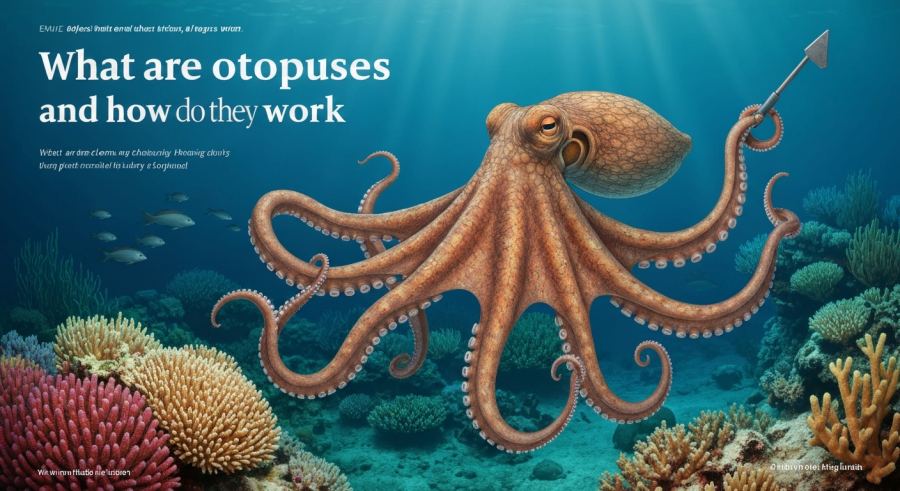
Octopuses are soft-bodied, eight-armed molluscs with three hearts, blue copper-based blood, and a nervous system so decentralised that two-thirds of their neurons live in their arms rather than their brain. Each arm thinks semi-independently. They hunt, camouflage, squeeze through tiny gaps, and demonstrate problem-solving intelligence — all with no skeleton and a lifespan shorter than most houseplants.
Here's the thing about octopuses. Every time you think you've found the weirdest fact about them, there's another one underneath it wearing a tiny hat made of shells (which they actually do — they collect coconut shells for shelter, the little hoarders). Understanding what octopuses are and how they work isn't just interesting biology. It's a proper lesson in how many different ways a nervous system can be built, and a reminder that nature didn't read our textbooks before designing these things.
The basic blueprint: what an octopus actually is
Octopuses belong to the class Cephalopoda, which puts them alongside squid, cuttlefish, and nautiluses. They're molluscs — the same broad group as snails and clams — which already tells you evolution has a serious sense of humour.
Most molluscs are slow, shelled, and not exactly plotting anything. Octopuses are none of those things.
The body plan is this: a bulbous head called a mantle, which contains most of the organs. Eight arms lined with suckers that can taste and smell simultaneously. No internal skeleton — just soft tissue and a single hard beak, tucked where the arms meet, used to crack crustacean shells and deliver a venomous bite. All octopuses are venomous, for the record. Most are harmless to humans. The blue-ringed octopus is a notable exception and will kill you efficiently despite being roughly the size of a golf ball.
The mantle houses the gills, three hearts, digestive system, and ink sac. The ink isn't just a smokescreen — it contains a compound called tyrosinase that irritates predators' eyes and temporarily disrupts their sense of smell. It's a biological pepper spray. Octopuses take self-defence seriously.
They move three ways: crawling on their arms, jet propulsion by forcing water through a siphon, and a sort of walking shuffle they use along the seafloor. Jet propulsion is fast but exhausting. See previous note about octopuses hating cardio.
The nervous system that rewrites the rules
This is where things get genuinely strange. An octopus has roughly 500 million neurons — comparable to a dog. But only about a third of those neurons are in the central brain. The other two-thirds are distributed across the arms themselves.
Each arm has its own neural cluster called a ganglion. This means an arm can react to stimuli, execute complex movements, and solve local problems without consulting the brain at all. The brain sends broad instructions — "get the crab" — and the arms work out the details independently.
Scientists have shown this by severing an arm from the body (grim, but informative). The detached arm continues responding to stimuli and attempting to pass food toward where the mouth used to be. For up to an hour. The arm didn't get the memo.
This is called a decentralised nervous system, and it's the reason what are octopuses and how do they work is such a useful question — because the answer forces you to abandon almost everything you assumed about how a brain has to operate.
Vertebrate intelligence is centralised. One brain, one command centre. Octopus intelligence is distributed — more like a network than a headquarters. It evolved completely independently from vertebrate intelligence, which means two wildly different paths arrived at similar problem-solving ability. That's called convergent evolution, and it's one of biology's best party tricks.
Three hearts and blue blood: the circulatory system
Three hearts sounds excessive. It's actually a workaround.
Octopuses use haemocyanin to carry oxygen in the blood, not haemoglobin like we do. Haemocyanin uses copper atoms where haemoglobin uses iron — which is why octopus blood is blue. It's less efficient at warm temperatures, but in the cold, deep ocean it performs well enough.
The problem is that haemocyanin is less efficient overall, so octopuses need higher blood pressure to move enough oxygen around. Hence three hearts. Two branchial hearts, one at each gill, push deoxygenated blood through the gills. One systemic heart pumps oxygenated blood to the rest of the body.
The systemic heart stops when the octopus swims hard by jet propulsion. This is why octopuses tire quickly when swimming and prefer crawling. They're not lazy — they're genuinely working around a cardiovascular constraint. (I'm choosing to find this relatable rather than embarrassing.)
Camouflage so good it shouldn't exist
Octopuses can change colour and skin texture in under a second. They match rocks, sand, coral, and algae with an accuracy that would embarrass most military hardware.
The colour change works through chromatophores — pigment-filled sacs in the skin that expand and contract via muscle control. Beneath those are iridophores, which reflect light structurally to produce iridescent colours without pigment. And beneath those are leucophores, which scatter white light. Three layers, all working simultaneously.
The texture changes — smooth to spiky to lumpy — come from papillae, small muscular bumps in the skin that can be raised or flattened in milliseconds.
Here's the part that breaks brains. Octopuses appear to be colourblind. Their eyes have a single type of photoreceptor, suggesting they can't distinguish colours the way we can. Yet their camouflage is chromatic — it matches actual colour. How they do this is genuinely unresolved. One leading hypothesis suggests their skin contains light-sensitive opsins that detect colour directly, essentially allowing the skin to see. Their skin might perceive colour even if their eyes technically don't. I can't improve on that. It's already perfect.
The detail most explainers skip: octopus sleep and dreaming
In 2021, researchers published observations of octopuses cycling through two distinct sleep states — one quiet, one active — with the active phase showing rapid changes in skin colour and texture. Flickering patterns moving across the skin in rapid sequences.
This active sleep phase looks remarkably like REM sleep in vertebrates — the phase associated with dreaming. The researchers speculated the colour changes might reflect something like a dreaming state, possibly replaying experiences from the day.
Whether octopuses actually dream is unknown. The honest answer is we don't have the tools to confirm it. But the neural activity is there, the sleep cycles are there, and the visible skin changes are there. Something is happening.
Most octopus explainers skip this because it's speculative. I'm including it because it's the most interesting open question in cephalopod biology right now, and you deserve the good stuff.
The honest opinion: octopus intelligence is being undersold
Here's my strong take: the scientific community has been too conservative about octopus cognition, and it's partly because octopuses are so physically alien that researchers kept looking for vertebrate-style intelligence markers and missing the point.
Octopuses have been documented using tools — collecting coconut shell halves, carrying them, and assembling them into shelters elsewhere. That's not reflexive behaviour. That's planning for future use. It meets the criteria for tool use that researchers spent decades reserving for primates and corvids.
They recognise individual human faces and treat different people differently, despite having no evolutionary reason to develop human-face-recognition ability. They play — prodding objects repeatedly with no goal other than what appears to be curiosity. Some show distinct personalities, with some individuals consistently bolder, shyer, or more aggressive than others of the same species raised in identical conditions.
The counterargument is that without language or social structure, we can't assess the upper limits of their cognition. Fair call. But the argument that they're not that smart because they don't communicate like primates is a bit like saying a hammer isn't useful because it's bad at screwing. Wrong tool for the wrong metric.
When NOT to bother with this: if you're trying to argue octopuses are "just" instinctive hunters, you'll find the evidence uncomfortable. The instinct-versus-intelligence line blurs badly here. That's not a problem with octopuses — it's a problem with how we've drawn the line.
The short, brutal truth about octopus lifespans
For an animal this cognitively sophisticated, octopuses live a tragically short time. Most species survive one to two years. Giant Pacific octopuses — the largest species, reaching arm spans of around four to five metres — live three to five years at most.
They're semelparous, meaning they reproduce once and die. Males die shortly after mating. Females stop eating entirely to guard their eggs, sometimes for months, and die after the eggs hatch. They spend their final weeks starving next to a clutch of eggs they'll never see grow up.
Evolution made something brilliant and then gave it the lifespan of a houseplant. It's not sad from the octopus's perspective — they don't experience it that way. But from a purely information-theoretic standpoint, it seems like a waste. Imagine having that nervous system for thirty years instead of two.
Scientists reckon the short lifespan is tied to fast reproduction — a life-history trade-off where you burn hot and fast rather than slow and long. It works at the population level even when it looks tragic at the individual level. Nature doesn't do sympathy. It does spreadsheets.
So there you have it. Eight arms that think for themselves, three hearts, blue blood, colour-changing skin that might be able to see, dreams we can't confirm, intelligence we keep underestimating, and a lifespan shorter than most gym memberships. The octopus is either the universe's greatest punchline or its finest proof that there's more than one way to be clever. Probably both. Eight times over.