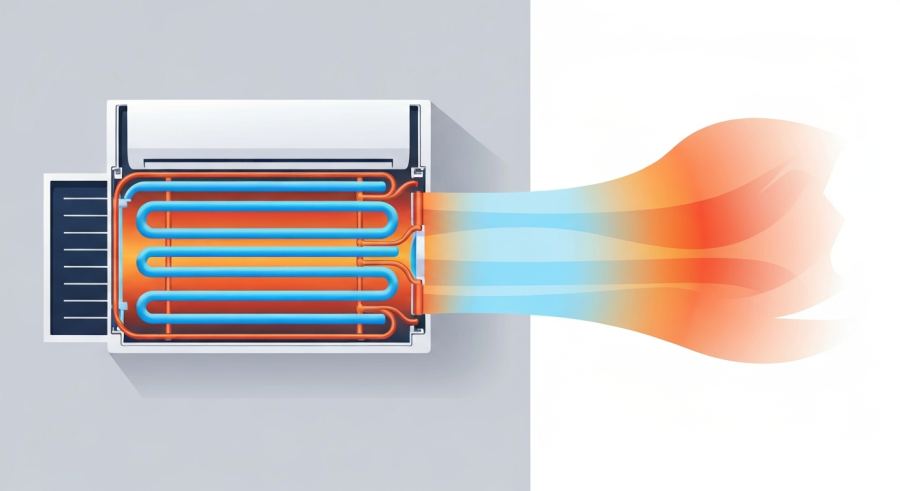
How does an air conditioner work? It moves heat from inside your home to outside — it doesn't generate cold air. A refrigerant fluid absorbs heat from indoor air at the evaporator coil, carries it outside, and releases it at the condenser coil. A compressor keeps the refrigerant cycling. Repeat until comfortable.
Most people assume an air conditioner is some kind of cold-making machine. A factory for chilliness. A fridge for your entire lounge room. It isn't. Understanding how an air conditioner works comes down to one idea: heat always moves, and your air conditioner is just telling it where to go. It's not creating cold — it's evicting warmth. Like a very efficient bouncer, but for thermal energy.
Cold Air Is a Lie (a Useful One)
Here's the thing about cold: it doesn't exist as a substance. Cold is just the absence of heat. You can't bottle cold and pump it into a room the same way you can't pour darkness out of a jar.
What your air conditioner actually does is remove heat. The indoor unit pulls warm room air across a cold coil. Heat transfers from the air into the refrigerant inside that coil. The now-cooler air gets blown back into your room. The heat, carried by the refrigerant, gets shipped outside and dumped there.
Your room feels cold because its heat has been physically relocated. The outdoor unit, meanwhile, is blasting warm air into your garden and feeling absolutely no guilt about it.
That's the whole trick. Everything else is just plumbing and physics.
How Does an Air Conditioner Work — the Full Cycle
The refrigerant cycle is a loop. Four stages, continuous, running as long as your unit is on.
Stage 1: Evaporation. Low-pressure refrigerant enters the indoor evaporator coil as a cold liquid. Warm room air passes over the coil. The refrigerant absorbs that heat and evaporates — turning from liquid to gas. The air, now stripped of its heat, gets blown back into the room.
Stage 2: Compression. The refrigerant gas travels to the compressor — the loud bit in your outdoor unit. The compressor squeezes the gas, which raises its pressure and temperature significantly. At this point, the refrigerant is a hot, high-pressure gas.
Stage 3: Condensation. That hot gas moves to the outdoor condenser coil. Outside air is blown over the coil. The refrigerant releases its heat into the outdoor air and condenses back into a liquid. This is why standing next to an outdoor unit on a hot day is a special kind of miserable.
Stage 4: Expansion. The liquid refrigerant passes through an expansion valve. Pressure drops suddenly. The refrigerant cools right down. It's now a cold, low-pressure liquid again — ready to head back inside and start the whole process over.
Round and round it goes. You could call it a well-oiled machine, except the refrigerant does most of the work, so perhaps a well-refrigerated one.
The Four Parts Doing All the Actual Work
Strip away the casing and the marketing and every air conditioner has the same four components.
The evaporator coil lives inside your home in the indoor unit. It's where heat gets absorbed from your room air. The refrigerant inside it is deliberately kept at low pressure so it evaporates easily and absorbs heat readily.
The compressor is the engine of the whole operation. It keeps the refrigerant moving and raises its pressure — which raises its temperature — so the heat can actually be released outdoors. When your air conditioner is loud, this is the culprit. When it dies, the whole system stops. Compressors are expensive. Treat them kindly.
The condenser coil sits in the outdoor unit. This is where heat gets dumped into the outside air. A fan blows air over the coil to help the process along. The bigger and cleaner this coil is, the more efficiently your system runs.
The expansion valve is the reset button. It drops the refrigerant's pressure rapidly, cooling it back down so the cycle can start again. Without it, the refrigerant would never get cold enough to absorb heat from your room.
Four parts. One loop. Surprisingly elegant for something that looks like a beige box bolted to your wall.
The Bit Most Explainers Skip: Why Humidity Matters
Most how-does-an-air-conditioner-work explanations stop at heat. They miss the moisture, which is actually half the reason air conditioning feels so good.
When warm, humid air passes over the cold evaporator coil, the coil's surface temperature is below the dew point of that air. Moisture condenses on the coil — exactly like water beads on a cold glass of lemonade in summer (the glass that always leaves a ring on the table, much to someone's annoyance).
That condensed water drips into a drain pan and gets piped away. The humidity leaves with it. The air coming back into your room is both cooler and drier.
This matters because humidity is what makes heat feel unbearable. Dry heat at 32°C is uncomfortable. Humid heat at 32°C makes you reconsider all of your life choices. Air conditioning addresses both problems simultaneously, which is why it's so much more effective than a fan in genuinely muggy conditions.
A fan just moves the misery around. An air conditioner removes it.
The flip side: in very dry climates, air conditioning can make indoor air uncomfortably dry. That's why people in desert regions sometimes run humidifiers alongside their air conditioning, which does feel like a very expensive way to put moisture back that you just paid to remove.
The Honest Opinion: Inverter Units Are Worth It, Fixed-Speed Units Are Not
Here's my strong take, and I'll back it properly: if you're buying a new air conditioner today, a fixed-speed (on/off) unit is the wrong choice in almost every situation.
Fixed-speed compressors run at full power until the thermostat is satisfied, then switch off entirely. They blast away, overshoot the target temperature slightly, switch off, let the room warm back up, then blast away again. It's the air-conditioning equivalent of driving by flooring the accelerator and then slamming the brakes alternately. Fuel-inefficient, uncomfortable, and hard on the components.
An inverter unit runs its compressor at variable speeds. It ramps up to cool the room quickly, then throttles back to a gentle cruise to maintain temperature. Quieter, more consistent, and — this is the key fact — inverter units typically use 30-50% less electricity than equivalent fixed-speed units in real-world use. That's not marketing. That's the physics of not running a motor flat-out when you don't need to.
The upfront cost of an inverter unit is higher. The running cost is lower, often substantially. In any climate where you'll use air conditioning more than a few weeks a year, the inverter unit pays for the price difference over time.
When should you not bother with a high-end inverter unit? If you're cooling a holiday shack you visit four times a year, a basic fixed-speed window unit is perfectly fine. Don't let anyone talk you into a premium system for a space you'll use occasionally. The maths simply doesn't work in your favour.
Rule of thumb: if you'll run the unit more than three months of the year, buy the inverter. If it's a guest room that gets used at Christmas, don't overthink it.
Summing Up
An air conditioner works by moving heat — from inside to outside, continuously, using a refrigerant that evaporates, compresses, condenses, and expands in a loop. It doesn't make cold. It steals warmth and abandons it in your garden. Along the way it removes humidity too, which is arguably the more impressive trick. Get the sizing right, buy an inverter unit if you'll use it often, and keep the outdoor coils clean. Do those three things and your air conditioner will reward you with years of comfortable, efficient service. Ignore them and you'll spend summer in a hot room wondering why your electricity bill looks like a phone number. Stay cool out there — the physics are on your side.