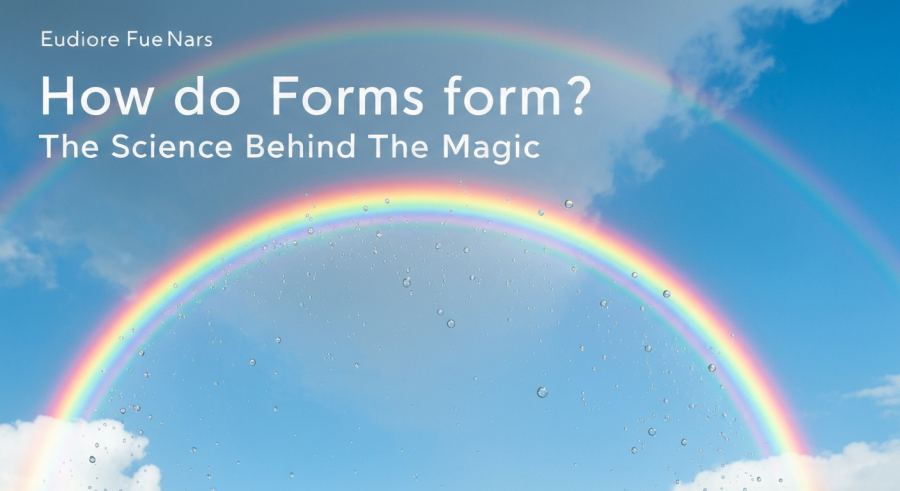
How do rainbows form? Sunlight enters a raindrop, bends, bounces off the back wall, and bends again on the way out — splitting into colours because each wavelength refracts at a slightly different angle. You see an arc because of your exact position relative to the sun and the rain. It's geometry, not magic. (Though admittedly it looks like magic.)
Every person who has ever pointed at a rainbow has been absolutely delighted and almost completely wrong about what they're looking at. It's not a thing in the sky. It's not sitting over there in that field. It's a direction — a precise optical relationship between you, the sun, and a curtain of water droplets. Rainbows form differently for every pair of eyes watching them. Which means if you've ever argued about where a rainbow ends, both of you were right and also both of you were wrong. Welcome to optics.
Light doesn't just pass through a raindrop — it gets redirected
Think of a raindrop as a tiny, wobbly lens with attitude. When sunlight hits the surface, it slows down and bends. That bending is called refraction. It happens because light travels slower in water than in air, and the angle of the surface forces it to change direction — like a shopping trolley hitting a kerb on one side first.
The light then travels to the back of the droplet. Some of it passes straight through (useless for rainbows). Some of it reflects off the back wall — bouncing back toward the front of the droplet like a tiny internal mirror. That's reflection.
Then, on the way out the front, the light refracts again. Two bends and one bounce. That's the whole mechanism. Physics pulling off a three-act play inside a sphere roughly 2mm across.
The full term for this combined process is dispersion — and how do rainbows form without it? They don't. Dispersion is the bit that separates white light into its component colours, because each wavelength refracts at a very slightly different angle. More on that below.
Why you see an arc, not a blob of colour
Here's the bit that trips people up. You're not looking at one special droplet. You're looking at millions of them, each sending one particular colour to your eye from one particular angle.
The geometry locks everything into a circle. Red light exits water droplets at roughly 42 degrees from the antisolar point — the point directly opposite the sun from your eyes. Violet exits at roughly 40 degrees. Every droplet that happens to sit at 42 degrees from your antisolar point sends red light to your eye. Every droplet at 40 degrees sends violet. The result, strung across the sky, is an arc.
That antisolar point is directly behind your head. Which means the sun must be behind you for a rainbow to be in front of you. If you're facing the sun, you're facing entirely the wrong direction. The rainbow is behind you, shaking its head.
The arc is actually a full circle — but the ground blocks the bottom half. From a plane, in the right conditions, you can see a complete circular rainbow. It's one of the more quietly spectacular things commercial aviation offers, usually somewhere between the bad pretzels and the screaming child three rows back.
The colours are sorted by physics, not by committee
White sunlight is a mixture of all visible wavelengths. Red has the longest wavelength in the visible spectrum. Violet has the shortest. When they both refract, violet bends more than red — it slows down more relative to the wavelength involved. That difference is only about two degrees of angle, but across a sky full of droplets it's enough to pull the colours apart into distinct bands.
The traditional order — red, orange, yellow, green, blue, indigo, violet — runs from the outer edge of the bow inward. Red on the outside, violet on the inside. You can remember it with Roy G. Biv, or you can just remember that red is always the top stripe, and work your way down. Either way works fine.
One honest note: a rainbow isn't seven colours. It's a continuous spectrum — infinite gradations of wavelength blending into each other. Newton chose seven because he liked the number, possibly because it matched the notes in a musical scale. Indigo, in particular, has been punching above its weight since 1666 and probably deserves a quiet retirement.
Double rainbows, moonbows, and the detail most explainers skip
This is the part most rainbow explainers either rush or skip entirely.
Double rainbows happen when light bounces twice inside the droplet instead of once. The second rainbow appears above the first, is noticeably fainter, and has its colours reversed — violet on the outside, red on the inside. The sky between the two bows, called Alexander's dark band, is measurably darker than the sky on either side. That band is dark because the geometry of double-reflected light doesn't send any colour to your eyes from that region. It's not a trick of contrast — the light genuinely isn't there.
Moonbows are real. They form exactly the same way as solar rainbows, using moonlight (which is just reflected sunlight) instead of direct sun. Because moonlight is so much dimmer, your colour vision barely activates — so moonbows appear white or pale grey to the naked eye. A long-exposure photograph will show full colour. They're most common near large waterfalls: Victoria Falls and Cumberland Falls in Kentucky are two reliable spots.
Fogbows are the understudy nobody books. They form in fog rather than rain, where the droplets are so tiny that diffraction interferes with the colour separation. The result is a broad, mostly white arc with faint reddish and bluish edges. Less dramatic than a rainbow. Still technically impressive. Like a cover band that plays all the notes correctly.
The honest opinion: Newton got one thing slightly wrong
Here's a strong take, and I'll back it properly: the seven-colour model of the rainbow has done more harm than good to public understanding of light.
Newton was a genius — arguably the most influential scientist who ever lived. But when he divided the visible spectrum into seven colours in the 1660s, he was partly motivated by numerology and musical analogy, not purely by optics. He wanted seven to match seven musical notes. So he squeezed indigo into the lineup as a distinct colour, even though most people's eyes can't reliably distinguish it from deep blue or violet.
The practical cost of this decision is that millions of people learn the rainbow as a seven-step list — ROYGBIV — and think of it as a fixed, discrete thing. It's not. It's a smooth, continuous gradient that shades imperceptibly from one wavelength to the next. Teaching it as a list of seven colours is like teaching music as seven individual notes with nothing in between.
This matters because it obscures the real lesson: that colour isn't a property of objects, it's a property of light and the eye receiving it. A rainbow is the most vivid demonstration of that available in everyday life. Reducing it to a mnemonic misses the point entirely.
My rule of thumb: if you want to understand how do rainbows form at a level that actually makes sense, ditch the seven-colour model and think in wavelengths. Red is roughly 700 nanometres. Violet is roughly 400. Everything in between is a gradient. That framing will serve you better than indigo ever will.
When should you not bother learning the detailed optics? Honestly, if all you want is to enjoy the view — don't. Standing in a field after rain, watching colours hang above the hills, is perfectly complete without knowing the refractive index of water. Some things you're allowed to just like. But if you want to understand why the sky does what it does, or you're teaching a kid who's asking good questions, the geometry here is worth ten minutes of your attention. It pays dividends.
So next time it rains and you're facing the right direction
Rainbows form from a collision of sunlight, water, and angle — all three arriving at exactly the right moment from exactly your position. The sun behind you. Rain ahead. And the geometry doing its patient, reliable work.
Each colour exits its droplet at a precise angle, and your eye catches the whole arc because millions of droplets are each playing their assigned note. It's a symphony conducted by physics, performed in a curtain of falling water, and viewed exclusively by you — because your rainbow is built for your eyes and nobody else's.
Which means, technically, every rainbow is a personal experience. Nature's way of saying it doesn't do group bookings.
The science doesn't make it less beautiful. If anything, knowing that two degrees of angle separates red from violet — that the whole dazzling arc hangs on a difference your eye can barely resolve — makes it more impressive. Not less. Just don't call it magic in front of a physicist. Or do. Life's short and the rain won't wait.