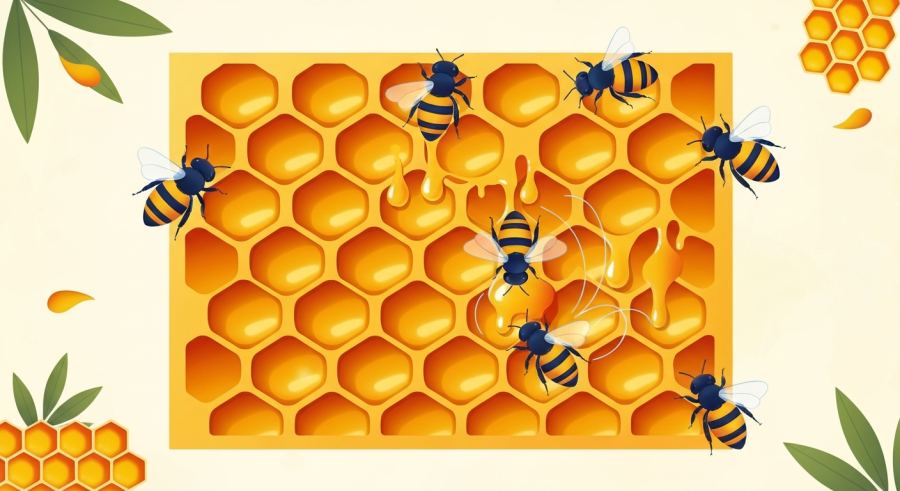
Most of us have a vague mental image: bee lands on flower, bee makes honey, honey ends up in a bear-shaped bottle. The actual process involves regurgitation chains, enzyme chemistry, and bees essentially running a tiny air-conditioning system with their wings. It's genuinely impressive, and it makes the bear-shaped bottle feel like the least interesting part of the whole story.
Samantha RobinsonJuly 1, 20267 min read196 views
It Starts at the Flower, Not the Hive
The raw ingredient for honey is nectar — a sugary liquid produced by flowering plants. Plants make nectar to attract pollinators. It's essentially a bribe. Bees take the bribe, accidentally cover themselves in pollen, and carry that pollen to the next flower. Both parties benefit. It's the oldest business arrangement in history, and neither side has ever filed a complaint.
A forager bee uses a long, tube-like tongue called a proboscis to suck nectar from flowers. She'll visit somewhere between 50 and 100 flowers per trip. The nectar is mostly water — around 80% — with the rest being sucrose and trace compounds depending on the plant species. That water content is the main problem the bees have to solve. More on that shortly.
Nectar composition varies wildly by plant. Clover, manuka, orange blossom — each produces nectar with a different sugar profile, water ratio, and trace flavour compounds. That's why honey tastes different depending on where the bees are foraging. The bees don't care about your charcuterie board, but the result is the same.
The Honey Stomach Is Not What You Think
Here's where it gets interesting. Bees have two stomachs. One is for digestion — same as you'd expect. The other, called the honey stomach or crop, is a separate pouch used exclusively to store and process nectar. It holds roughly 40mg of liquid, which is close to 80% of a forager bee's body weight when full.
This is a critical distinction. The honey stomach isn't part of the bee's digestive tract. Nectar doesn't mix with digested food. So when people say honey is "bee vomit," they're being dramatic. It's more like a specialised transport container that also happens to do some chemistry along the way.
While the nectar sits in the honey stomach, glands in the bee's mouth secrete an enzyme called invertase. Invertase breaks sucrose — a complex sugar — into two simpler sugars: glucose and fructose. This breakdown is what makes honey sweeter and more stable than the original nectar. The bee is essentially a flying chemistry lab. A small, fuzzy, occasionally bad-tempered flying chemistry lab.
Back at the Hive: The Mouth-to-Mouth Bit
When the forager returns to the hive, she doesn't deposit the nectar directly into cells. Instead, she passes it to a house bee through a process called trophallaxis — which is a word scientists use so they don't have to say "they spit it into each other's mouths repeatedly." The house bee chews and manipulates the nectar, adding more enzymes from her own glands.
This gets passed between multiple bees. Each transfer adds more enzymatic activity and begins to reduce the water content slightly through evaporation in each bee's mouth. It's a relay race, except the baton is pre-honey and everyone's mouth is involved.
Eventually the partially processed nectar gets deposited into a honeycomb cell. At this point it's still too watery to count as honey — closer to 50–70% water, depending on the nectar source. The real work is just beginning.
Evaporation Is the Slow, Unglamorous Magic
How do bees make honey shelf-stable? They dry it out. Bees fan the open honeycomb cells with their wings, creating airflow through the hive. This evaporates water from the nectar. The hive also maintains a temperature of around 35°C, which helps the process along.
The bees keep fanning until the water content drops to roughly 17–20%. At that point, the honey is thick, viscous, and stable. The bees then cap each cell with a thin layer of beeswax, sealing it for storage. That capping is the bee equivalent of putting a lid on the jam jar.
The whole evaporation stage takes several days to a couple of weeks depending on temperature, humidity, and how much nectar is being processed at once. If the water content stays too high, the honey ferments. Bees are very good at not letting this happen. They've had about 150 million years of practice.
The Thing Most Explainers Skip: Why Honey Doesn't Rot
This is the part that deserves more attention. Honey is one of the only natural foods that genuinely doesn't spoil. Properly sealed honey found in ancient Egyptian tombs — thousands of years old — has reportedly been tasted and found edible. That's not a fun myth. It's real, and it has a chemical explanation.
Three things make honey inhospitable to bacteria and mould. First, the water content is too low for microbial growth. Most bacteria need water activity levels above 0.94 to survive; honey sits around 0.6. Second, honey is acidic — pH roughly 3.5 to 4.5 — which further inhibits most microorganisms.
Third, and this is the bit people miss: during processing, an enzyme called glucose oxidase reacts with glucose and trace amounts of oxygen to produce hydrogen peroxide. Low levels, but enough to be antimicrobial. This is part of why honey has been used medicinally for wound care across many cultures. It's not folk nonsense — there's solid chemistry behind it.
The honey doesn't corrode. The jar does. Buy better jars.
Strong Opinion: We Underestimate How Hard This Actually Is
Here's my take: the cultural image of honey as a passive natural product — something bees just sort of generate — undersells one of the most sophisticated collective manufacturing processes in the animal kingdom.
A single forager bee produces roughly 1/12 of a teaspoon of honey in her entire lifetime. Her entire lifetime. To fill a standard 450g jar requires around 550 bees collectively flying roughly 55,000 miles — more than twice around the earth. That's not a poetic statistic. That's the actual logistics.
And the enzyme chemistry involved isn't simple. Invertase, glucose oxidase, catalase — bees produce all of these from specialised glands. The humidity management inside the hive is precise enough to be measured in percentages. The capping decision — when exactly the water content is low enough — is somehow made collectively, without a supervisor, by insects with brains roughly the size of a sesame seed.
Industrial food production employs chemists, engineers, and humidity-controlled facilities to achieve results bees figured out tens of millions of years ago. I reckon if bees had a LinkedIn, their "About" sections would actually be justified for once.
Don't bother romanticising it too hard, though. A bee doesn't know it's making honey. It's following chemical signals. The sophistication is real; the intentionality isn't. That distinction matters if you're writing a nature documentary script. For everyone else, it's still extraordinary.
The Whole Process, Start to Finish
To pull it all together: a forager bee visits 50–100 flowers, fills her honey stomach with nectar, returns to the hive, and passes the nectar mouth-to-mouth through several house bees. Enzymes break the sucrose into glucose and fructose throughout this process. The resulting liquid is deposited into honeycomb cells, fanned to evaporate water over several days, and sealed with beeswax once the water content hits around 17–20%. The chemical properties of the finished product — acidity, low water activity, hydrogen peroxide — make it shelf-stable essentially forever.
That's the full answer to how bees make honey. Forager collects, enzymes convert, house bees process, wings evaporate, beeswax seals. Roughly one to three weeks, 550 bees, 55,000 miles of collective flight, one jar.
Next time you squeeze that bear-shaped bottle, I reckon you owe those bees a moment of silence. Or at minimum, stop leaving the lid off.
Frequently Asked Questions
Bees collect nectar from flowers using a long tongue, store it in a special honey stomach, and pass it between bees back at the hive. Enzymes break the nectar down, bees fan it to evaporate the water, and once it's thick enough, they seal it with beeswax. That sealed stuff is honey.
Roughly one to three weeks from nectar collection to capped honey. The evaporation stage is the longest part — bees fan the nectar until the water content drops to around 17–20%. Rush it and it ferments. Bees don't rush it.
Around 550 bees fly roughly 55,000 miles collectively to produce a single pound of honey. A standard 450g jar represents an almost absurd amount of flying. Next time you leave honey in the cupboard for two years, maybe feel slightly guilty about that.
Honey is food storage for winter. Bees can't forage when it's cold, so they spend summer packing away enough honey to survive until spring. A healthy hive might store 25–30kg of honey in a good year. They're not making it for us. We're just opportunistic.
The key enzyme is invertase, secreted from glands in the bee's mouth. It breaks sucrose (from nectar) into glucose and fructose. Another enzyme, glucose oxidase, produces hydrogen peroxide as a byproduct — which is partly why honey has antimicrobial properties and lasts essentially forever if sealed.
Technically it's closer to regurgitation than vomit — bees have a separate honey stomach (the crop) specifically for storing and processing nectar. It never mixes with digested food. So 'bee vomit' is a fun thing to say at dinner but it's not quite accurate. 'Enzymatically processed nectar' doesn't have the same ring to it, though.
Honey's low water content (around 17–20%) and acidic pH create an environment where bacteria and mould can't survive. The hydrogen peroxide produced during processing helps too. Honey found in Egyptian tombs thousands of years old was reportedly still edible. That's not a metaphor. It literally lasts forever if kept sealed.
No. Only honeybees (genus Apis) and some stingless bee species make honey in quantities worth harvesting. Bumblebees produce tiny amounts of something similar but don't store it long-term. Solitary bees don't make it at all. So the next time someone says 'save the bees' — they mean all of them, even the ones not pulling their weight in the honey department.