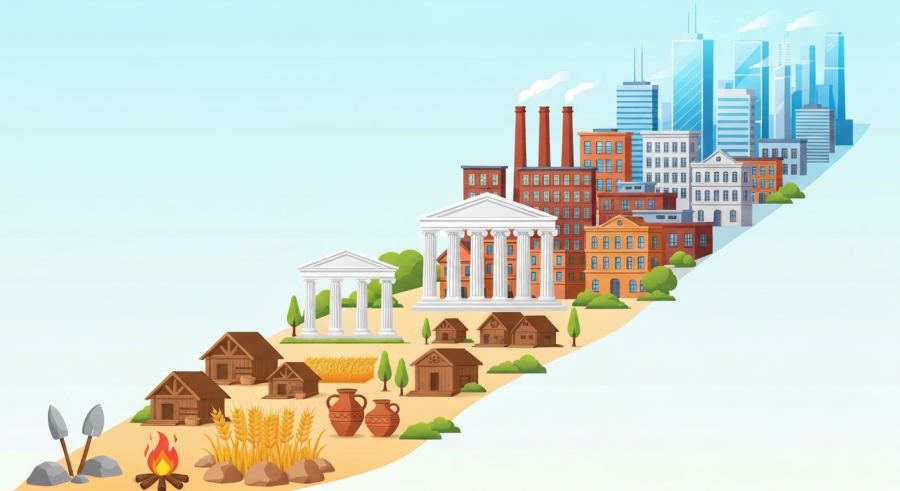
How Did Human Civilization Develop from Prehistoric Times to the Modern Era?
Here's the thing about human history — it looks inevitable in hindsight and completely improbable in the moment. We started as a mid-tier African primate with no claws, no venom, and genuinely mediocre speed. Now we're launching cars into space for fun. How did human civilization develop from prehistoric times to the modern era? It's the longest pub quiz answer in existence, and honestly, the story is wilder than most people realise. Let's go through it properly.
Andrew MartinezJuly 1, 202610 min read93 views
The Prehistoric Starting Line: Caves, Tools, and Fire
Homo sapiens appeared around 300,000 years ago. The fossil evidence from Jebel Irhoud in Morocco is currently the oldest we have.
For most of that time, humans lived in small nomadic bands. Hunters and gatherers, moving with seasons and herds. No permanent settlements. No kings. No tax returns. (Genuinely the one era of human existence where that last point tracks as a positive.)
The crucial developments in this period weren't dramatic. They were slow and cumulative.
Fire control, which likely began before Homo sapiens even arrived, changed everything. Cooking food increased caloric yield. That fed bigger brains. Bigger brains built better tools. Better tools caught more food. It's a feedback loop that powered our entire species.
Stone tools became progressively more refined — from rough Oldowan choppers to delicate Acheulean hand axes to the fine blades of the Upper Paleolithic. Around 40,000 to 50,000 years ago, something shifted. Cave paintings appeared. Bone flutes showed up. Symbolic thinking — the ability to represent one thing with another — seemed to accelerate dramatically. We call this the Upper Paleolithic Revolution, and nobody is entirely sure what triggered it.
Language is the leading theory. Once you can tell someone exactly what happened two valleys over, knowledge survives beyond the individual. That's the first version of civilisation's cloud storage.
How Human Civilization Developed Its First Big Upgrade: Agriculture
Around 10,000 to 12,000 years ago, humans in the Fertile Crescent — modern-day Iraq, Syria, Turkey, and nearby — started deliberately cultivating wild wheat and barley. They also domesticated sheep, goats, and cattle.
This wasn't a decision. Nobody held a committee meeting and voted to invent farming. It was gradual — incidental tending of useful plants, then selective replanting, then deliberate cultivation over generations.
But the consequences were enormous and not entirely positive (more on that in a moment).
Farming created surpluses. Surpluses meant not everyone had to find food all day. So some people became potters, weavers, soldiers, priests. Specialisation begat trade. Trade begat wealth. Wealth begat hierarchy. Hierarchy begat states. States begat bureaucracy.
You see where this is going. The modern world is basically a very complicated argument that started when someone first said "this grain is mine."
Agriculture spread outward from the Fertile Crescent, and also developed independently in China (rice and millet, around 7000 BCE), Mesoamerica (maize, around 7000 BCE), and sub-Saharan Africa (sorghum and yams, somewhat later). Parallel invention. Humans in unconnected places looked at wild plants and had identical ideas. We're predictable like that.
Cities, Writing, and the Ancient Empires That Actually Invented Civilization
By around 3500 BCE, Mesopotamia had cities. Uruk, in what is now Iraq, is often cited as the first true city — population estimates range from 25,000 to 80,000 at its peak. By ancient standards, absolutely enormous. By modern standards, roughly the size of a mid-tier English market town with better mythology.
Writing appeared in Mesopotamia around 3200 BCE, initially as a bookkeeping system. Cuneiform started as clay tablets tracking grain deliveries. The first written documents are essentially receipts. The most human thing imaginable — even our greatest technological leap started with paperwork.
Egypt, the Indus Valley, and China all developed urban civilisations within a few thousand years of each other, each with distinctive writing systems, monumental architecture, and complex administrations.
These ancient empires — Akkadian, Babylonian, Egyptian, Assyrian, Persian — traded, warred, collapsed, and reformed. They built legal codes (Hammurabi's is the famous one, around 1754 BCE). They developed mathematics, astronomy, medicine. They created cultural output that still circulates: epic poetry, religious texts, architectural forms.
Greece and Rome then synthesised and expanded on these traditions, adding their own contributions in philosophy, law, engineering, and political theory. Roman roads connected a territory stretching from Scotland to Mesopotamia. Roman law still underpins legal systems across Europe and beyond. Not bad for a civilisation that thought lead pipes in the water supply was a perfectly sensible idea.
The Middle Bit: Collapse, Recovery, and a Lot of Feudalism
Around 1200 BCE, the Bronze Age Collapse wiped out most of the civilisations in the Eastern Mediterranean within a generation. The causes are still debated — drought, earthquake, invasion, systems collapse — and the mystery is genuinely one of history's great unsolved problems.
From the wreckage came the Iron Age, new empires, and eventually the classical world. Then Rome fell — slowly, across the 4th and 5th centuries CE in the West, with the Eastern half (Byzantine Empire) lasting until 1453.
Medieval Europe is often dismissed as a dark gap between Rome and the Renaissance. That's unfair and largely wrong. The Islamic Golden Age (roughly 8th to 14th centuries) preserved and advanced Greek and Roman knowledge in mathematics, medicine, astronomy, and philosophy. Chinese civilisation produced paper, printing, gunpowder, and the compass — all of which eventually changed Europe irrevocably. The Mongol Empire, brutal as it was, connected trade routes across Eurasia on an unprecedented scale.
By 1450 CE, the pieces were in place for something new.
How Human Civilization Developed Its Modern Shape: Industry and Revolution
The printing press (Gutenberg, around 1440) is genuinely one of the most consequential inventions in history. It industrialised the copying of information. Within 50 years, millions of books existed where thousands had before. The Protestant Reformation, the Scientific Revolution, and the Enlightenment all rode the printing press into the mainstream.
The Scientific Revolution of the 16th and 17th centuries — Copernicus, Galileo, Newton — replaced authority-based knowledge with evidence-based knowledge. That shift in epistemology — how we know what we know — is arguably the deepest revolution in human intellectual history.
Then the Industrial Revolution, starting in Britain around the 1760s, replaced human and animal muscle with machines powered by steam and coal. Productivity exploded. So did urban populations, pollution, and economic inequality. The 19th century created modern capitalism, modern socialism, and modern nationalism more or less simultaneously, which explains why the 20th century was such an argument.
The 20th century itself compressed more change than any previous era: two world wars, nuclear weapons, decolonisation, the green revolution in agriculture, antibiotics, aviation, space travel, and the internet. A person born in 1900 who lived to 1990 witnessed more technological change than the previous hundred generations combined.
The Edge Most Historians Undersell: Luck Was a Huge Factor
Here's what most grand narratives of civilisation quietly skip: geography did an enormous amount of the work.
Eurasia's east-west axis meant crops and animals domesticated in one region could spread across similar climates relatively quickly. Wheat domesticated in the Fertile Crescent could grow in Greece, Italy, France, and India without much adaptation. The Americas, oriented north-south, faced climate barriers that slowed the spread of Mesoamerican crops into North and South America.
Eurasia also had the lion's share of domesticable large mammals: horses, cattle, pigs, sheep, goats. Animals that could be used for labour, food, and — critically — that gave humans diseases. Those diseases eventually devastated populations in the Americas and elsewhere that had no prior exposure and no immunity. That's not a moral judgement. It's a biological catastrophe that shaped which civilisations expanded and which collapsed on contact.
The civilisations we tend to celebrate as "advanced" had huge advantages they didn't earn. Acknowledging that doesn't diminish the genuine human ingenuity involved. It just makes the story more honest.
My Honest Take on the Story We Tell About Progress
Here's my strong opinion, and I'll stand by it: the standard narrative of civilisation as a linear march from primitive to advanced is not just wrong — it actively misleads us about the problems we face now.
The "onwards and upwards" story implies that where we are is the logical endpoint of history. It isn't. The Roman Empire lasted roughly 500 years at its most generous count. We are not immune to collapse. Civilisations have always assumed they were the pinnacle.
The agricultural revolution is a good example of the problem with simple progress narratives. Farming made large populations possible. It also made people shorter, sicker, more hierarchical, and more vulnerable to famine than their hunter-gatherer predecessors for thousands of years. The skeletons tell the story. Average height dropped noticeably at the transition to farming. Disease increased dramatically. So did interpersonal violence in settled communities.
We traded freedom for density and then called it progress. Fair enough — the density eventually produced writing and cities and antibiotics. But the honest version acknowledges the costs.
When should you be sceptical of the progress narrative? When it's used to justify present inequality by suggesting it's the natural outcome of history. It isn't. The distribution of wealth, power, and technological benefit at any given moment reflects political choices as much as historical inevitability.
Human civilisation developed because humans are extraordinarily good at cooperation — at building institutions, sharing information, and solving collective problems. That's the actual superpower. Not tools, not agriculture, not the steam engine specifically. The underlying capacity to coordinate at scale. Every civilisation that collapsed did so, in part, because that coordination broke down.
The good news: coordination is a skill. We've gotten better at it, despite overwhelming evidence to the contrary on any given news day.
Where We Ended Up
We started with fire, flint, and a remarkable brain that hadn't quite figured out what to do with itself. We built languages, farms, cities, empires, machines, and global networks. We wrote down everything from grain receipts to epic poetry to the collected works of everything you've ever searched online. We made enormous mistakes and occasionally fixed them.
The story of human civilisation is not a straight line. It's more like a very long, very chaotic pub crawl — some brilliant conversations, several regrettable decisions, a few fights, and somehow we made it to last orders still standing.
The tab, admittedly, is enormous. But so is the story.
Frequently Asked Questions
Modern humans — Homo sapiens — showed up roughly 300,000 years ago in Africa. That's based on fossil evidence from sites like Jebel Irhoud in Morocco. For context, if Earth's history were a 24-hour clock, humans arrived at about 11:58 PM. We are extremely recent tenants.
Agriculture appeared independently in several regions around 10,000 to 12,000 years ago, starting in the Fertile Crescent. It also developed separately in China, Mesoamerica, and parts of Africa. Farming didn't spread from one place — humans in multiple spots looked at wild plants and had the same big idea simultaneously.
Usually a combination of factors: drought, overextension, disease, economic collapse, and invasion. Rome didn't fall on a Tuesday because of one bad decision. It took centuries of internal dysfunction, military overstretch, and external pressure. Nine times out of ten, collapse is slow, then sudden — like a bad roof finally giving way.
The Bronze Age, roughly 3300 to 1200 BCE depending on region, saw humans alloy copper with tin to make bronze tools and weapons. It matters because it enabled organised warfare, trade networks, and early state-building. Without bronze, there's no Trojan War, no Egyptian empire at its peak, and no dramatic mythology for Hollywood to ruin.
Writing transformed civilisation by allowing information to survive beyond a single human memory. Mesopotamian cuneiform, Egyptian hieroglyphics, and Chinese oracle bone script all appeared within a few thousand years of each other. Suddenly you could record debts, laws, and stories. Civilisation basically became possible to scale the moment humans could write a receipt.
A mix of factors: coal availability, property rights that rewarded inventors, colonial resource extraction, and urbanisation. Britain had the right combination of fuel, capital, and legal protection for innovation around the 1760s. James Watt's improved steam engine is the famous starting gun, though the race had been building for decades before that.
Not even close. Geography played a massive role — Jared Diamond's 'Guns, Germs, and Steel' makes a strong case that axis orientation, available domesticable animals, and crop types shaped how fast societies advanced. Continents aligned east-west (like Eurasia) shared innovations faster than those aligned north-south, where climate zones blocked the spread of crops.
Cities formed because agriculture created food surpluses, and surpluses let some people stop farming and start specialising — as potters, soldiers, priests, or merchants. Why dig when you can trade? Once specialisation took hold, people clustered together for efficiency. The first cities appeared in Mesopotamia around 3500 BCE, and the concept proved rather popular. It stuck.